Let's be honest — the garden shed is the last frontier of the beautifully organized home. We'll spend three weekends sourcing the perfect rattan pendant for the living room, but the moment we step outside, we tolerate a chaos of tangled hoses, leaning rakes, and orphaned trowels that would make any Remodelista editor weep quietly into her oat latte. The outdoor space deserves better. And right now, a quiet revolution is happening in yards and garages across the country — one where storage becomes part of the design language, where a pegboard can carry as much visual weight as a gallery wall, and where the sea-glass palette of a coastal summer bleeds right out the back door into the shed.
This is the hill I'll die on: how you store your tools tells me more about your design sensibility than your sofa choice. Anyone can pick a good sofa. Real spatial intelligence is what happens in the overlooked corners — the garage wall, the shed entrance, the patch of fence nobody Instagram-worthy is watching. Get those right, and the whole outdoor room coheres. If you've already sorted your patio design, tool storage is the next logical chapter — and it's more interesting than you'd think.
The Pegboard Moment You've Been Avoiding
Cedar pegboard has become the design world's favorite utilitarian canvas — and for once, the hype is earned. The warm grain of cedar resists moisture without needing a finish, ages into a silvery driftwood tone over time, and provides the kind of backdrop that makes even a basic rake look intentional.
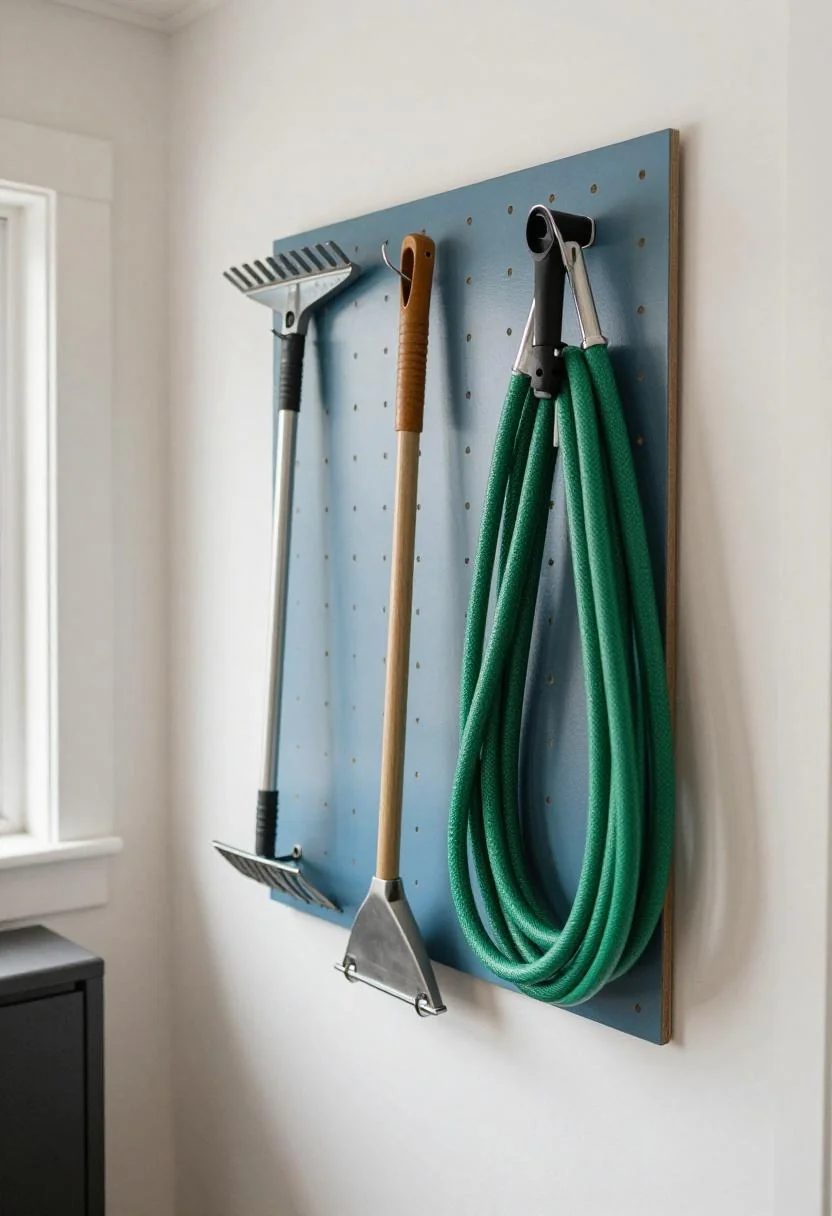
This cool blue garage setup does something most storage solutions don't: it uses color as architecture. The blue tones on the wall read like a washed coastal shutter — Farrow & Ball's Lulworth Blue territory — which grounds the natural cedar and makes the tools read as display, not clutter. The hose is coiled with the same care you'd give a linen throw on a day bed. That's the shift in thinking this whole trend demands. Cedar pegboard panels are widely available and worth every penny over the plastic alternative.
How to Get the Look: Mount your pegboard horizontally at shoulder height. Use hooks of varying lengths for depth — flat hooks for hand tools, J-hooks for long handles. Leave deliberate negative space between groupings. That empty space is not wasted; it's the visual breathing room that separates "organized garage" from "design moment."
Steel, Seriously
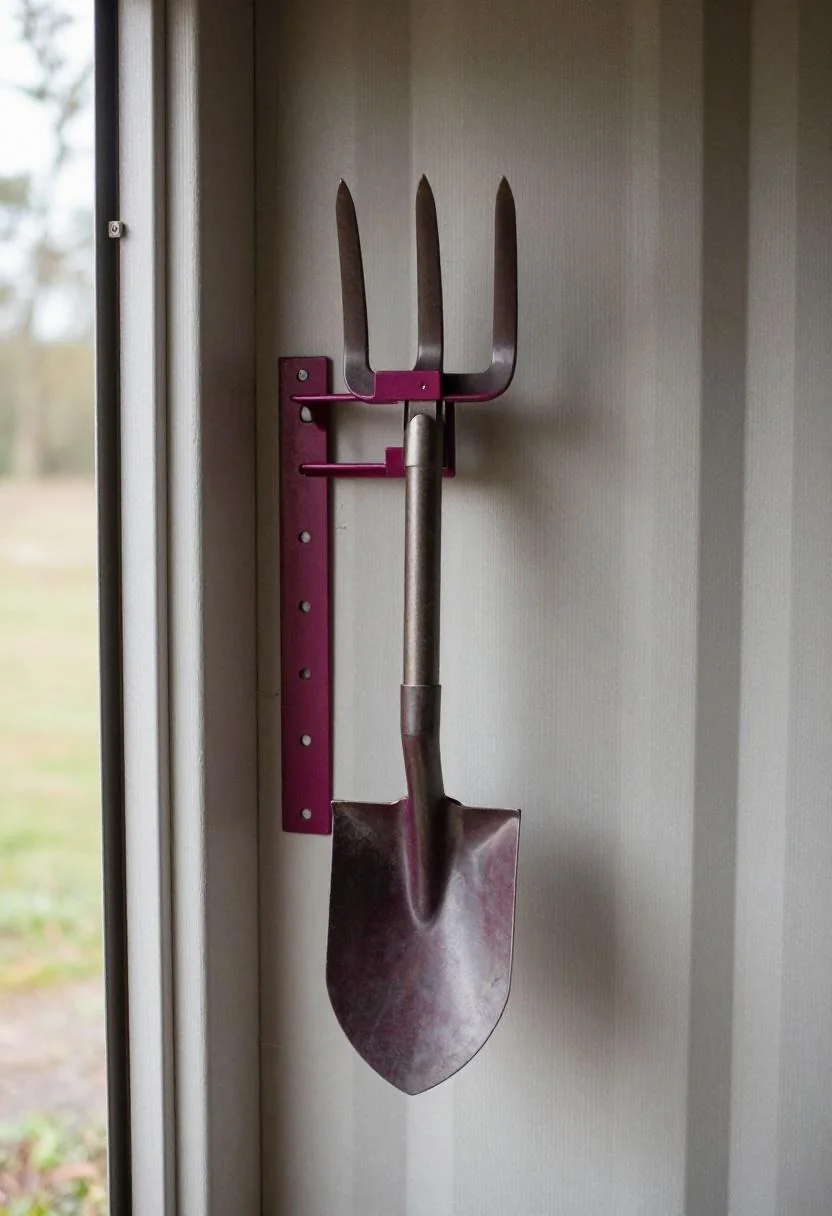
Controversial take: a vertical steel tool stand is more interesting than a custom built-in, because it's honest about what it is. This plum noir pairing — the deep aubergine of the shed wall playing against raw steel — is as close to a Brutalist design moment as a garden will ever get. The shovel and fork lean with the casual confidence of sculptures you didn't commission but definitely claimed credit for at the dinner party.
Free-standing steel stands require zero installation. Zero holes in the shed wall. For renters, for anyone who changes their mind quarterly (I see you), this is the answer. Vertical garden tool stands in powder-coated steel age beautifully and take on a patina that only gets better.
Bamboo, Rattan, and the Case for Natural Caddy Storage
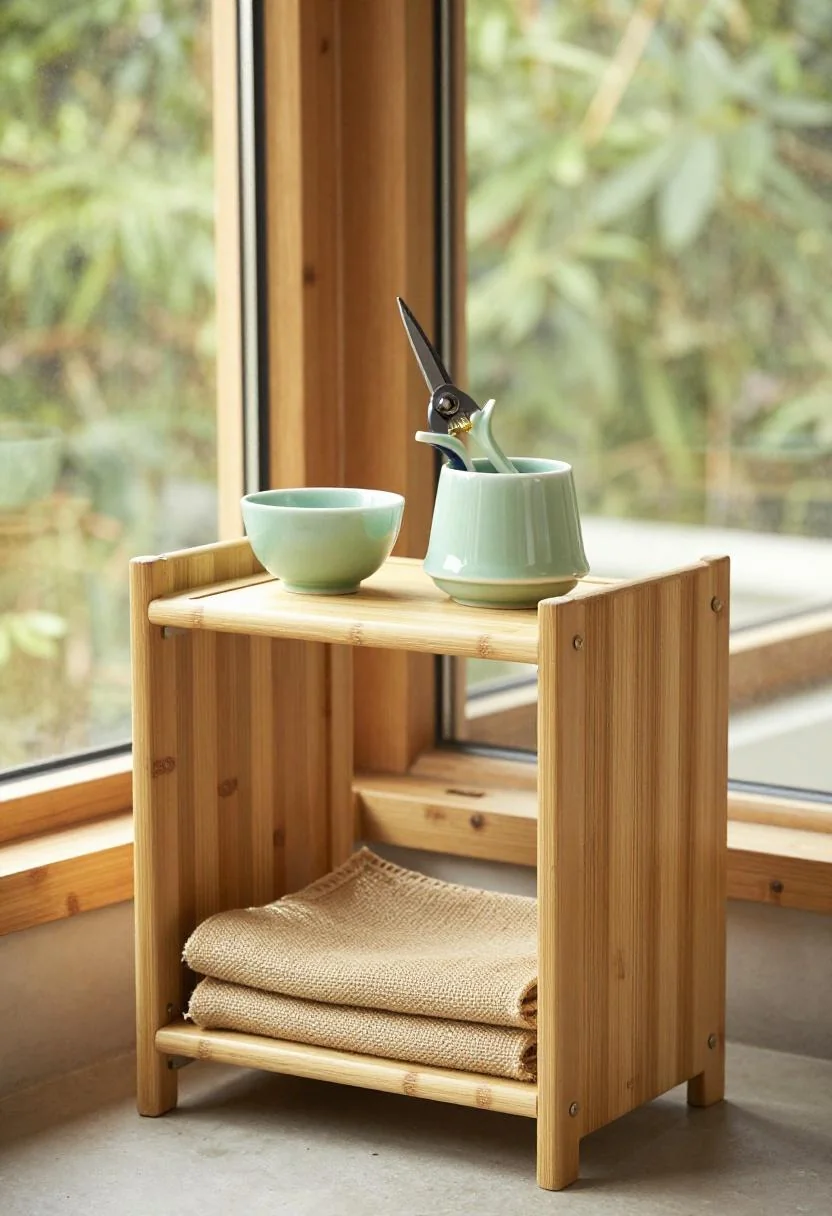
Here's what nobody's telling you about tool caddies: the material matters as much as the function. A bamboo caddy sitting in a jade green shed corner is not just organizational — it's a texture story. The warm grain of the bamboo against painted-concrete walls, a kneeling pad folded with the precision of a poolside towel, pruning shears resting at a slight angle like they've been placed by someone who thought about it. This is coastal beach-house energy applied somewhere no one expected it.
Bamboo caddies work because they're lightweight enough to carry into the garden and structured enough to keep tools vertical. The jade green on that shed wall, by the way, is doing serious heavy lifting. It's the color of sea glass after a winter storm — not tropical, not saccharine, just deeply considered. As Elle Decor has pointed out, outdoor paint color is one of the most underutilized design decisions homeowners make. Stop painting your shed brown out of obligation.
Wall Hooks — But Make Them Mean It
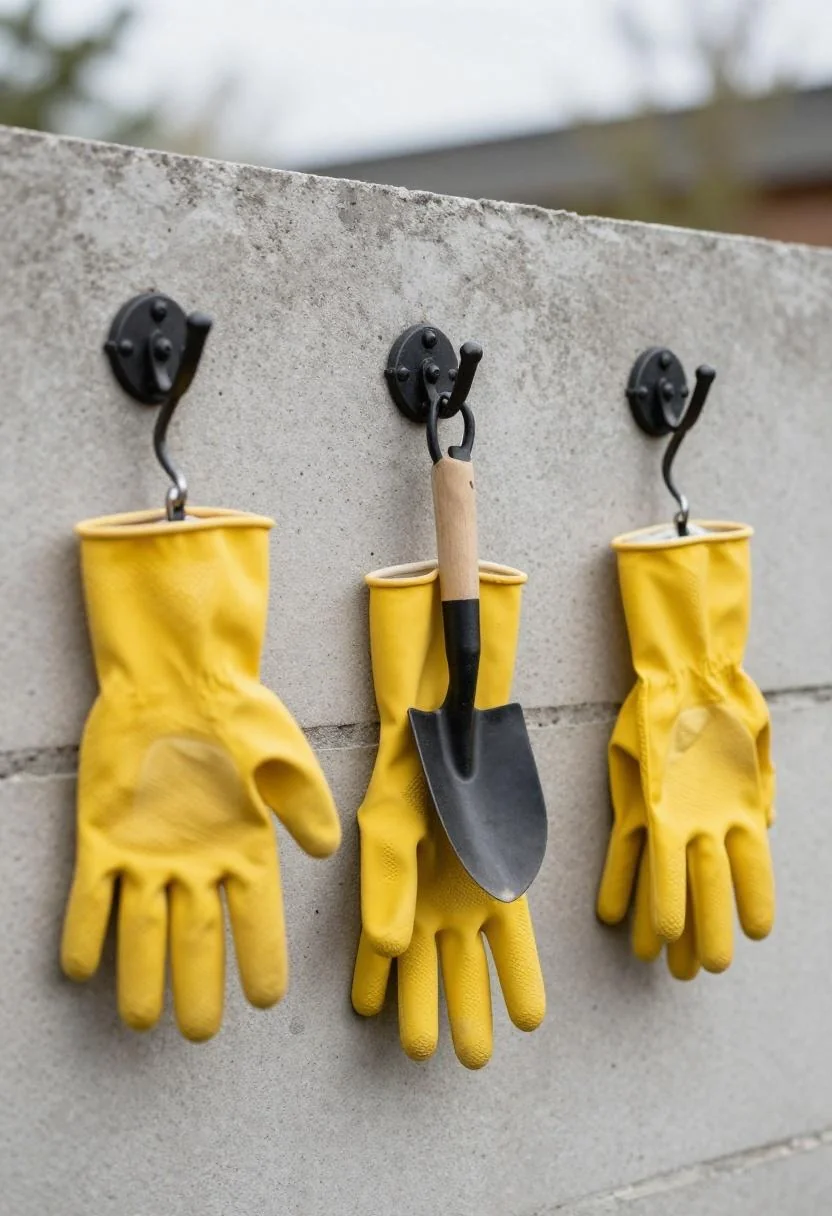
Wrought-iron wall hooks on a garden wall are the outdoor equivalent of an entryway hook rail — and the same rules apply. Placement is everything. Too high and nothing is retrievable. Too low and the visual rhythm collapses. These wasabi-yellow gloves are the real design decision here: that chartreuse-adjacent pop against dark iron and stone wall is the kind of accidental color theory that makes a garden feel curated without being precious about it.
The trowel hanging alongside the gloves completes the still life. One hook, one trowel, two gloves. That's it. Restraint is the move. Heavy-duty wrought-iron hooks in black finish weather without rusting and develop that handsome oxidized surface over time — which, for the record, looks far better than anything powder-coated in the garden context.
The Galvanized Utility Shelf: Industrial Coastal Done Right
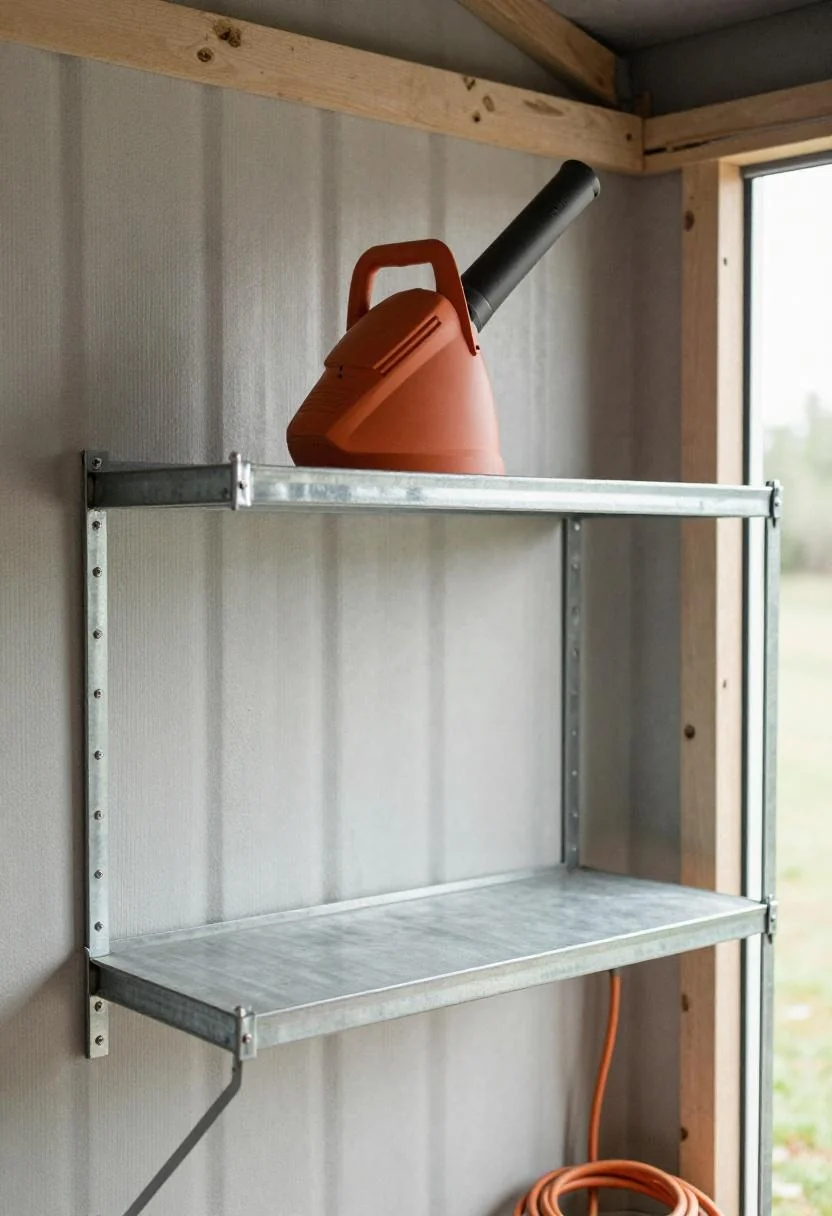
Galvanized steel reads coastal the moment you pair it with the right accent color. That persimmon-handled leaf blower sitting on a utility shelf is the kind of small chromatic decision that interior designers obsess over — the way a rust-orange cushion anchors a white slipcovered sofa. The extension cord, coiled and clipped, is functional. The persimmon is the punctuation.
Utility shelves should be rated for actual weight. Not decorative. The mistake most people make is buying a shelf that looks industrial but collapses under the leaf blower after six months. Go for wall-mounted options with adjustable brackets — they're more adaptable as your tool collection shifts. And yes, tool collections shift. Anyone who tells you otherwise hasn't been gardening long enough.
The Open Cabinet: Pine, Terracotta, and Actual Warmth
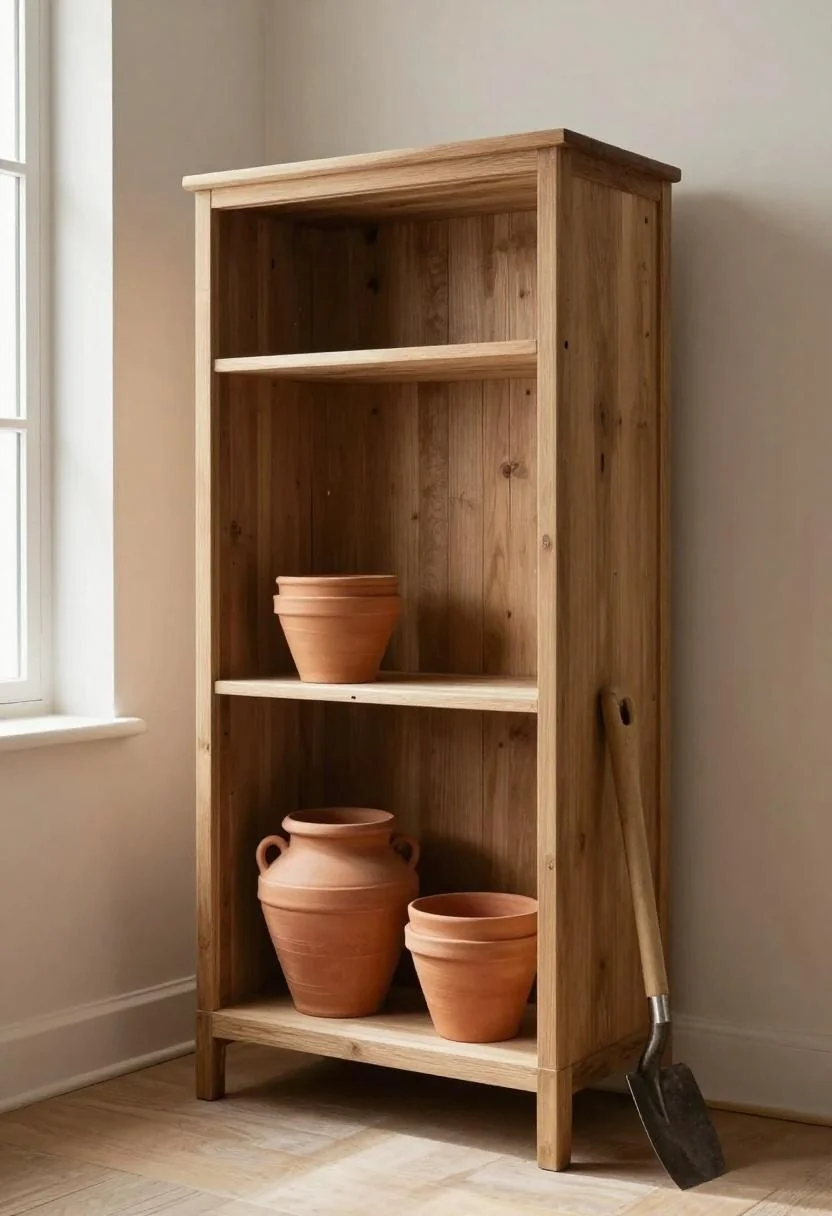
A pine open cabinet in a garden shed is essentially the farmhouse kitchen applied outdoors — and it works for the same reasons. Warm wood, open shelving, objects with visual weight and story. The terracotta pots grouped at the bottom of this cabinet are doing something structurally interesting: they anchor the composition the way a plinth anchors a sculpture. The spade vertical beside them keeps the scale honest.
Terracotta and pine together create that Provençal, sun-warmed Mediterranean warmth that feels equally at home in a coastal garden — which shouldn't work on paper but absolutely does in practice. (I've argued this point at length in the context of Mediterranean villa design, and the principle translates directly to the shed.) The cabinet doesn't need doors. Open storage invites engagement with the space. Doors just delay the inevitable mess anyway.
How to Get the Look: Group pots by size — largest at base, smallest at top. Let the spade or fork handle lean against the inner cabinet wall at a slight angle. Resist the urge to decorate further. The tools are the decoration.
Overhead Storage: The Vertical Dimension Nobody Uses
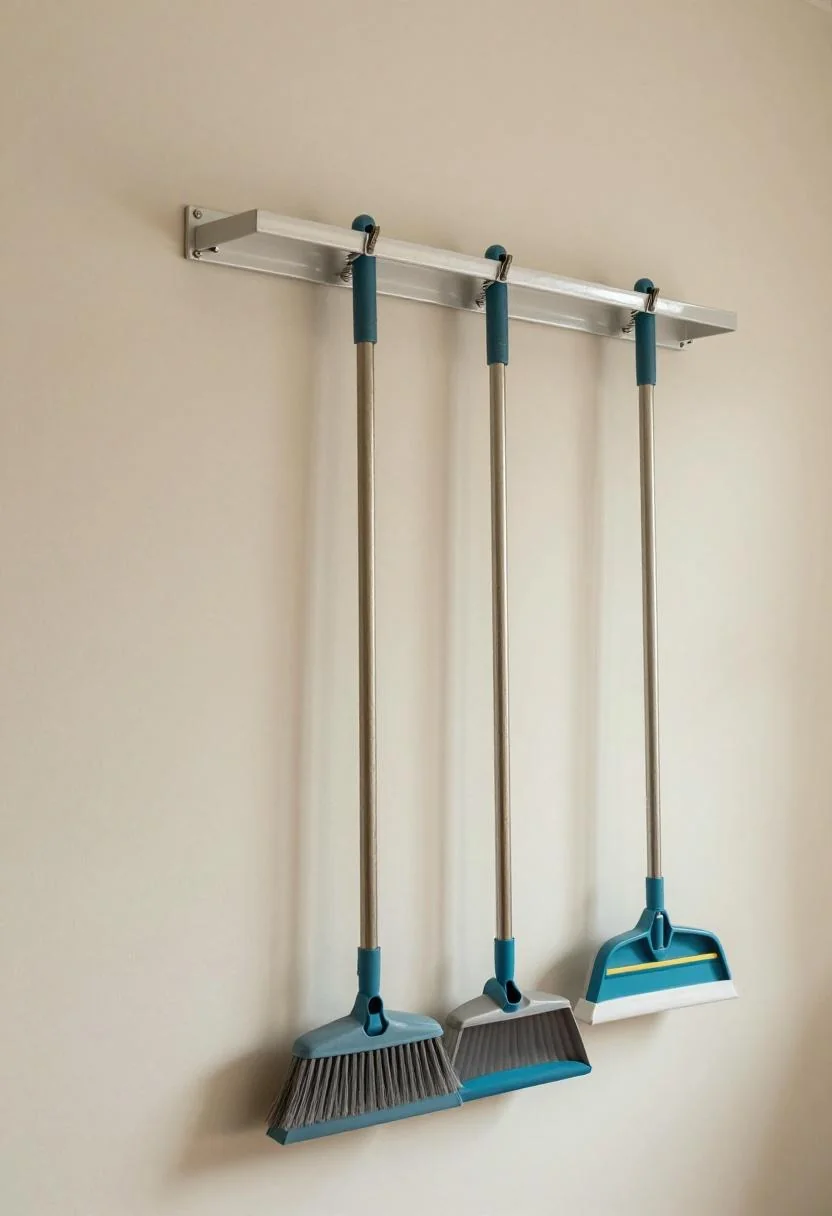
Cream white steel on a garage wall is a quieter choice than it appears — and the right one. The cream reads softer than stark white under garage fluorescents, closer to whitewashed linen than hospital corridor. Against that backdrop, brooms and mops stored vertically become graphic elements. Vertical lines. Repeated rhythm. This is minimalism with utility, and it happens to photograph beautifully.
Wall racks with spring-loaded grippers are the only real innovation in this category worth mentioning. They release with a tap, grip with weight, and require zero bending. If you've been resting brooms against a wall and wondering why they always fall at 2am when the house is quiet — this is your solution. Wall-mounted broom racks in powder-coated steel are inexpensive and transformative in a way most garage upgrades aren't.
Pipe Rails, S-Hooks, and the Beauty of Visible Systems
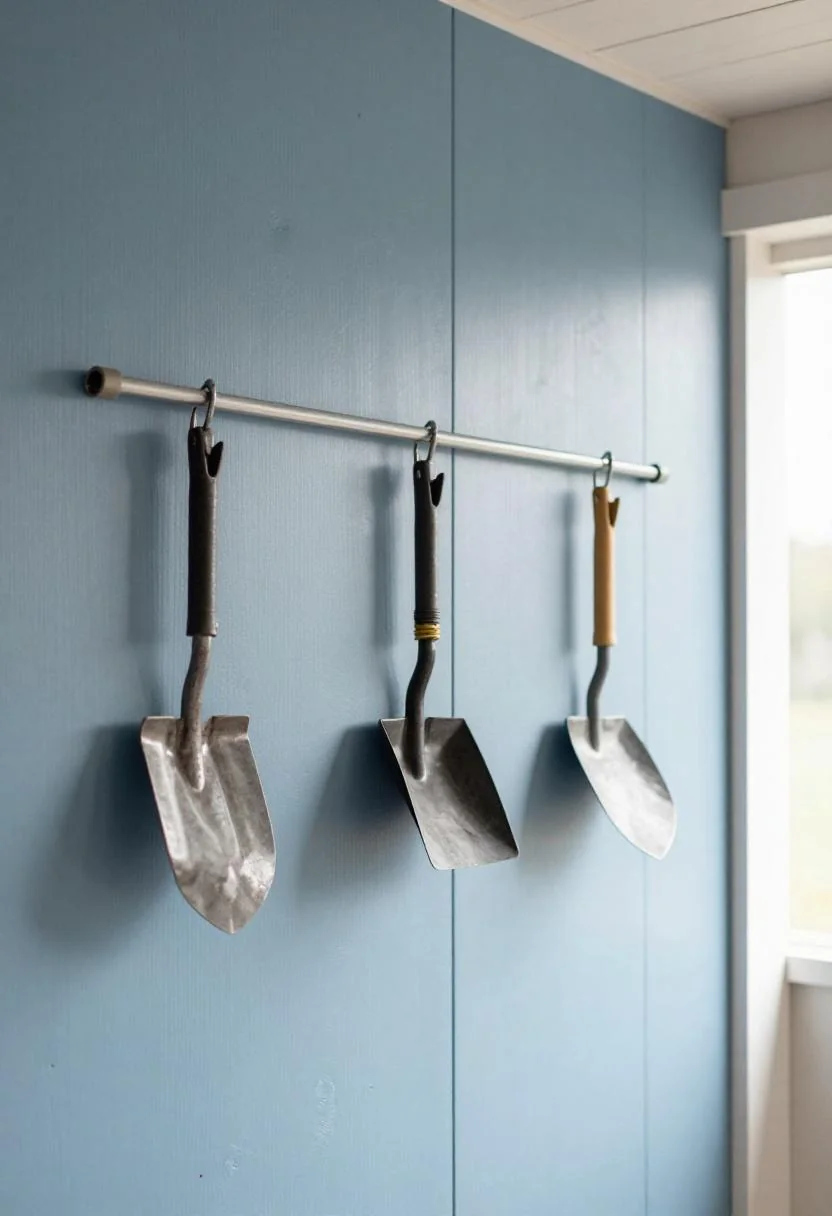
The industrial pipe rail trend migrated from loft kitchens to garden sheds, and the result is, frankly, better in the shed. That cool blue painted wall behind these pipe rails gives the whole system the feeling of something you'd find in a well-designed boathouse — utilitarian in origin, unexpectedly beautiful in context. S-hooks allow total flexibility: shift, add, remove without any tools.
What makes this work visually is the color behind the system, not the system itself. Paint that shed wall — actually commit to a color — and whatever you hang on it will look considered. Pipe conduit from any hardware store, cut to width and mounted on simple flanges, costs almost nothing. The S-hooks are even cheaper. As Architectural Digest has noted repeatedly, garage and shed organization is one of the highest-ROI design investments per dollar spent. This setup proves it.
Oak Shelf, Dark Accents, and the Shed Entrance as Design Statement
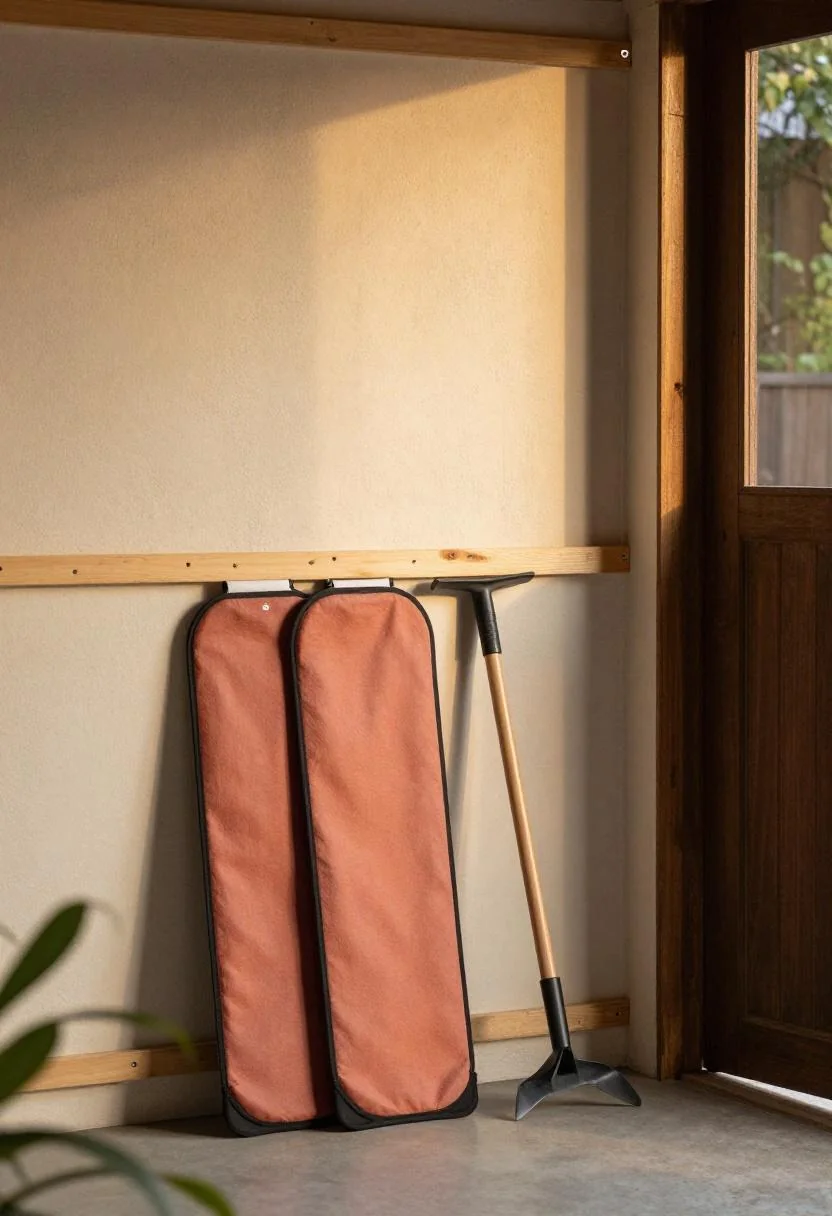
The shed entrance is overlooked as a design zone, which is a mistake. It's the transition space — from the garden into storage — and it sets the organizational tone the moment you step through the door. An oak wall shelf positioned near the entrance, holding plum noir kneeling pads and a hand cultivator, works as a kind of decompression station. Everything you'll need for a quick garden session is right there, at arm's reach, before you've gone searching.
Plum noir — that deep, almost black aubergine — against natural oak is a color pairing that interior designers use inside homes constantly. There's no reason it stops at the back door. The kneeling pads folded in a stack have the tonal weight of a stack of linen cushions. And the cultivator, hung on a single hook, is the exclamation point.
The Enamel Wall Bin: Small Object, Large Personality
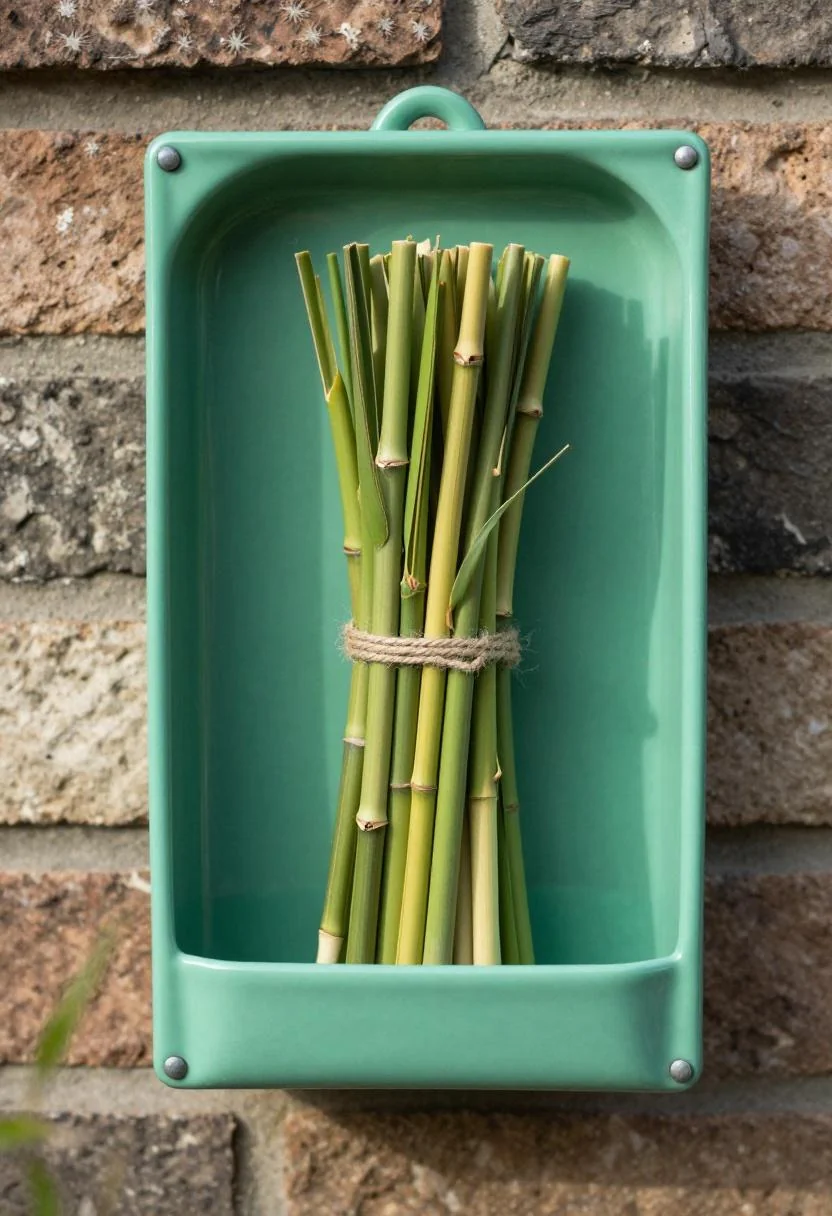
A jade green enamel wall bin on a brick garden wall is the kind of detail that makes visitors think you've hired a garden designer when you absolutely have not. The enamel surface carries that mid-century utilitarian quality — the aesthetic of old European kitchen storage, enamel canisters on open shelves — applied to bamboo plant stakes in a garden setting. It's a small object doing enormous design work.
Brick walls are actually the best backdrop for mounted storage because the mortar joints give you mounting flexibility. That jade green against the warm brick orange is color-wheel complementary without announcing itself as such. This is how you do coastal color theory outdoors: not starfish, not anchors, just the sea-glass tones placed with confidence in unexpected locations. Enamel wall bins are small enough to be an impulse purchase and consequential enough to change the whole shed's personality.
The Rolling Cart That Goes Everywhere
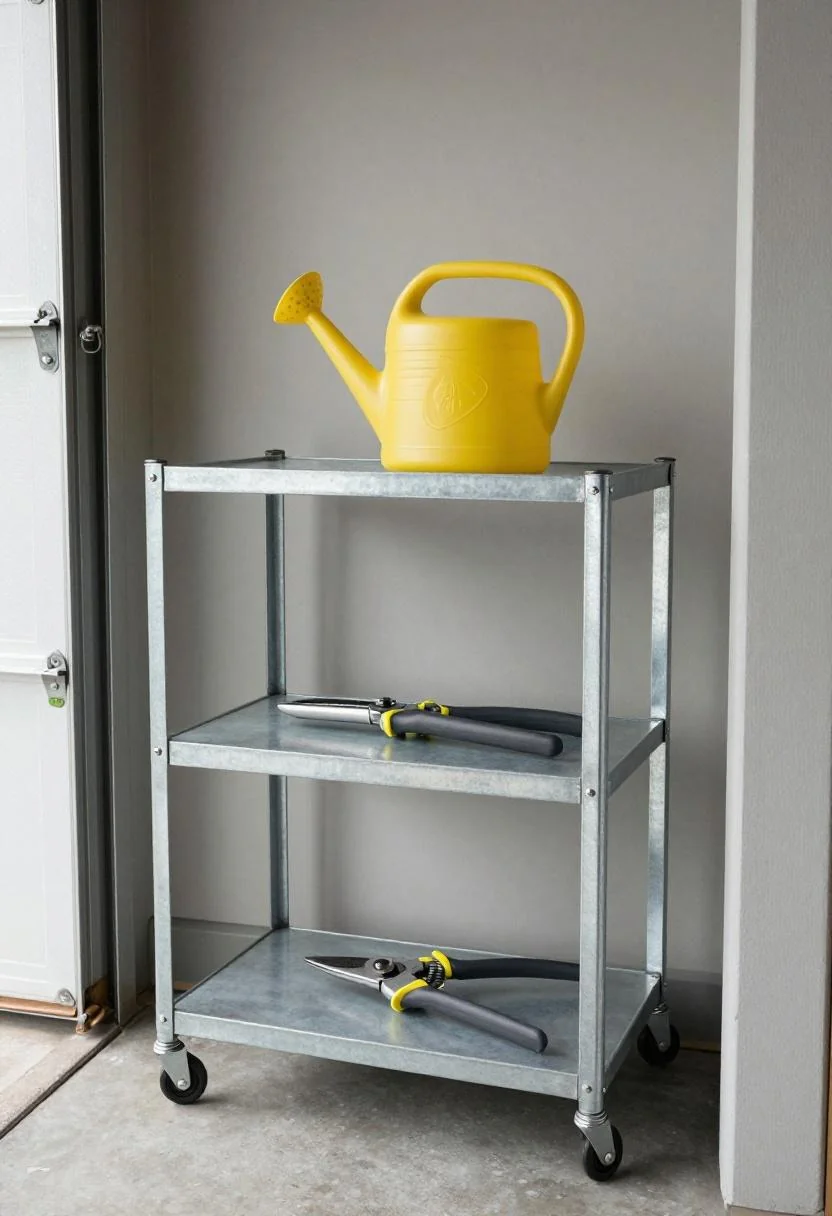
Mobility is underrated in garden storage. The galvanized rolling cart has been a kitchen staple — anyone who's visited a professional kitchen has seen the steel cart as a workhorse — and it belongs in the garage with equal authority. The wasabi watering can sitting on the lower shelf brings that same acidic chartreuse energy we saw in the wall hooks earlier, and paired with loppers resting across the top tier, the cart becomes a self-contained garden station you can wheel exactly where you need it.
The wasabi-to-galvanized pairing is the coastal version of utility: clean, salt-air functional, slightly sun-bleached in spirit. Rolling carts also make rearranging the garage for seasonal tasks genuinely easy — something no fixed shelving unit ever manages. This is the one item I'd tell you to prioritize if you're starting from scratch. Galvanized rolling utility carts range from compact two-tier to generous three-tier versions — size up if you have the floor space.
The Tool Tower: A Vertical Architecture All Its Own
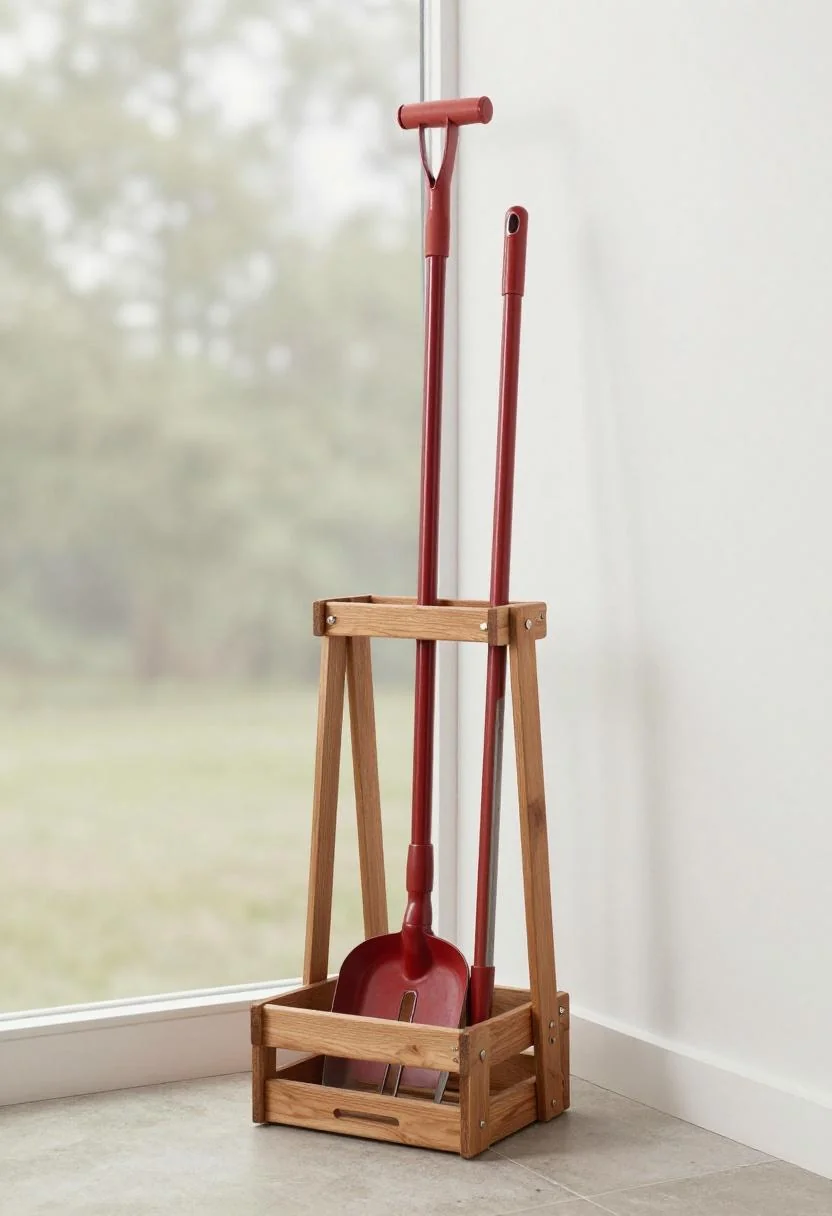
Here's the thing about corners: they're almost always wasted space in a shed. A cedar tool tower solves the corner problem with the kind of vertical logic that makes you wonder why you didn't do this immediately. Long-handled tools — rakes, spades, forks — stored upright in a tower arrangement take up a fraction of the floor footprint they'd otherwise consume. And the persimmon hand fork tucked into a side slot is the kind of small detail that completes the composition.
Cedar again, and the reasons are the same: moisture resistance, natural aging, and that warm-grain quality that makes even the most utilitarian structure look designed rather than improvised. If you're building out a full shed interior — and you should think of it as an interior — the tool tower is the anchor piece around which everything else organizes itself. The way a wardrobe anchors a bedroom. The way an island anchors a kitchen.
Want a longer-term outdoor storage solution? Check out our guide to budget-friendly outdoor design for ideas that extend the same considered approach to the full yard.
The Wall Niche: When Storage Becomes Architecture
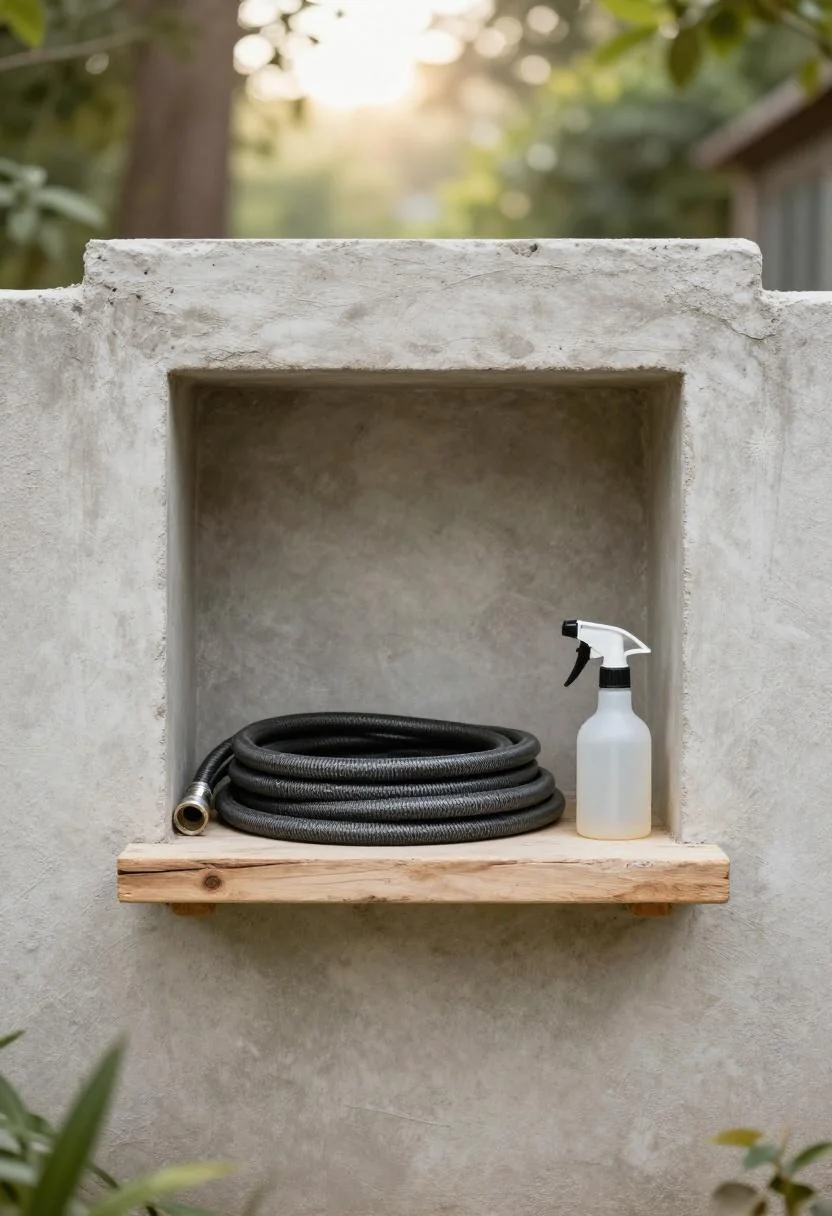
A terracotta wall niche with a pine shelf is, objectively, the most architectural storage solution in this guide — and also the most committed. You're not hanging a hook. You're creating a recess in the wall. But if you can make it happen, either by working with an existing alcove or by framing one into a new shed build, the result looks like something designed by an Italian garden architect in 1970 and only just rediscovered.
The coiled hose sitting in this niche like a piece of functional sculpture. The spray bottle upright beside it. The pine shelf bringing warmth against the terracotta render. This is the image I'd pin if I were planning a garden renovation — not for the hose storage specifically, but for the proof of concept that the utilitarian and the beautiful can share the same wall. As Harper's Bazaar has documented in its garden coverage, the distinction between indoor design thinking and outdoor design thinking is increasingly irrelevant to the designers doing the most interesting work.
Making It Your Own: If a full niche isn't possible, approximate the effect by building a simple shadow-box frame around a wall shelf, painted in the same terracotta tone as the surrounding surface. The eye reads depth even when the depth is minimal.
Making It Your Own: The Palette and the Principle
What does the best yard tool storage have in common? Color intentionality. The cool blues, jade greens, and wasabi yellows we've looked at throughout this guide aren't accidental — they're the chromatic language of a coastal summer applied to the most overlooked corner of the outdoor home. Terracotta and plum noir bring depth and warmth. Persimmon punches through galvanized grey with the confidence of a buoy at sea. The cream white of an overhead rack keeps a garage from feeling like a hardware store.
The principle underneath the palette: treat your storage as you'd treat any designed surface in the home. Choose one or two accent colors and repeat them through handles, bins, and hooks. Pick one dominant material — cedar, galvanized steel, bamboo — and let it unify the space. Leave negative space deliberately. And stop apologizing for your tools. A well-hung rake is as honest and satisfying as a well-designed shelf. Maybe more so — nobody's pretending it's anything other than exactly what it is.
If this has you rethinking the whole outdoor room concept, the work on the exterior matters just as much — our piece on half barrel planters for patios is a natural next step for carrying this considered approach through the full yard.
This post contains affiliate links. We may earn a commission at no extra cost to you.
Images in this article were created with AI assistance.


