Red, white, and blue. Three colors that arrive every July carrying the weight of expectation — bunting, balloons, the whole loud ceremony of it. And yet, handled with care, these same colors can do something quieter. Something that feels considered rather than performed. The best patriotic flower arrangements don't announce themselves. They settle into a space and make it feel more itself.
That tension — between the celebratory and the restrained — is exactly what makes July 4th florals interesting right now. As Vogue has observed in recent seasons, the move away from maximalist tablescapes toward intentional, material-led arrangements is real and gathering momentum. Natural vessels. Honest textures. Blooms that look like they were gathered, not engineered.
This guide is for the woman who wants to mark the holiday without surrendering her aesthetic to it. For the front porch, the dining table, or the garden path — these fifteen arrangements show how red, white, and blue can speak softly and still be heard. If you're thinking about your full outdoor setup, our guide to patriotic front porch decor for the Fourth of July covers the broader picture.
The Vessel Is the First Decision
Before you choose a single bloom, choose the container. This is where Japandi thinking earns its place in the patriotic conversation: the vessel isn't backdrop, it's structure. A ceramic urn reads differently than a plastic bucket — even with identical flowers inside. The materiality of the container sets the emotional register of the entire arrangement.
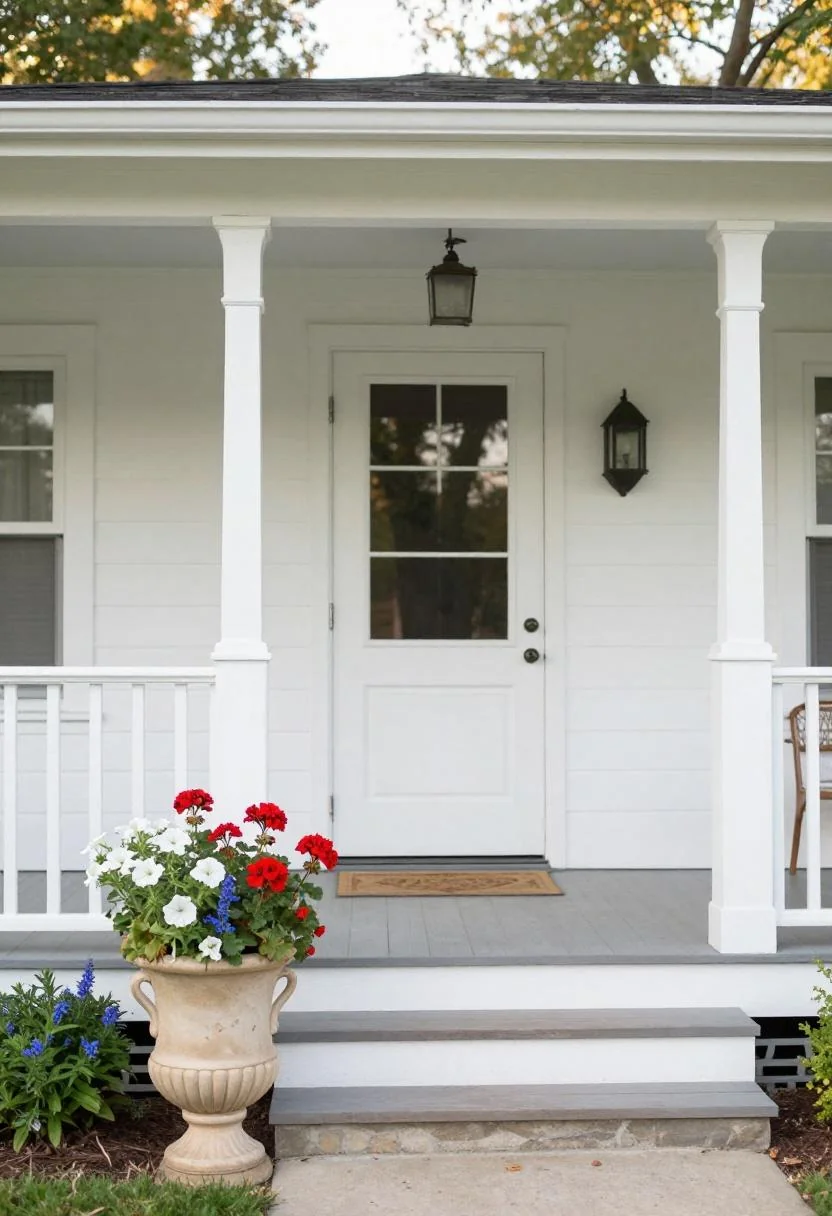
A ceramic urn at golden hour does something specific to patriotic colors. The warm light softens the red, cools the blue slightly, and makes the white glow. Flanking a porch railing with two matching urns creates symmetry without stiffness — the blooms themselves provide enough organic movement to keep it from reading as formal. This works because the urn is doing the structural work, leaving the flowers free to be flowers. Shop ceramic outdoor urns
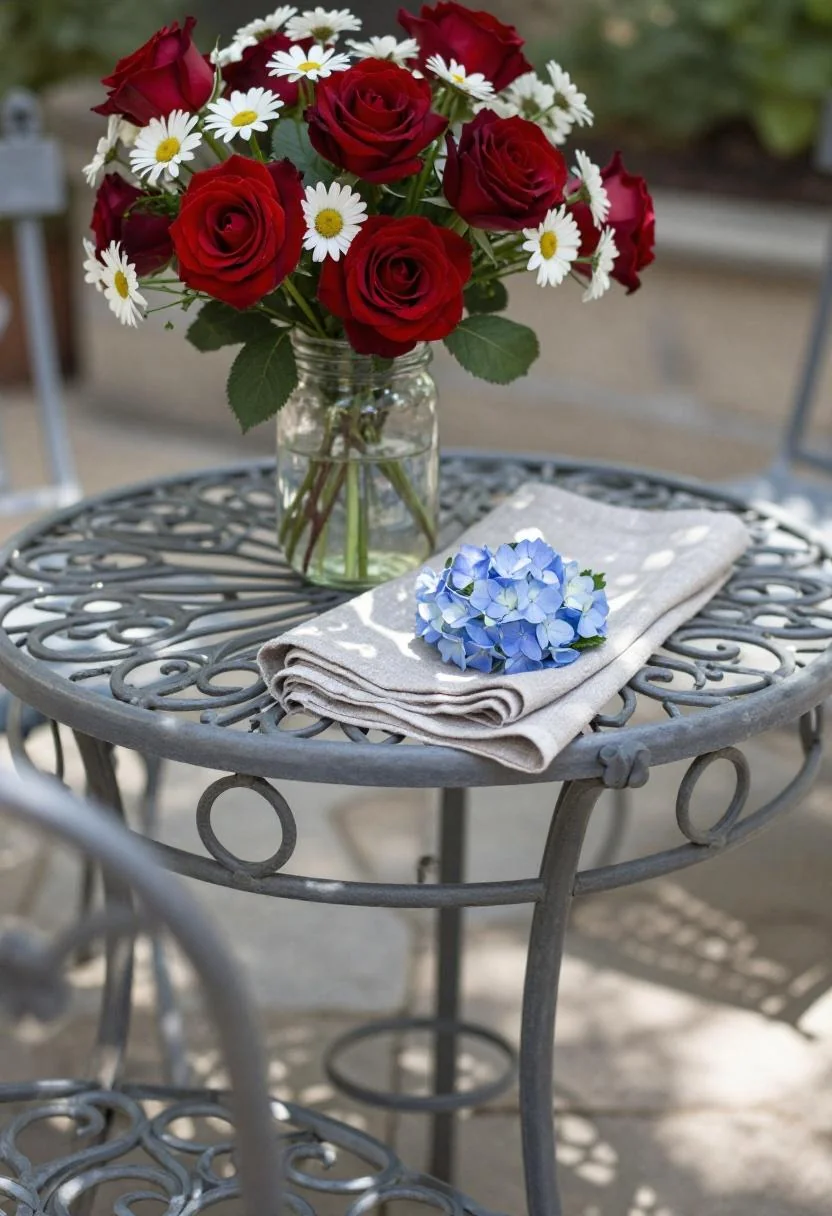
The mason jar is the most democratized vessel in American outdoor decorating — and that's not a criticism. On a shaded stone patio table with plum linen underneath, it stops being a cliché and starts being a choice. The plum accent is the move here. It deepens the blue in the arrangement without competing with it, and it keeps the whole tableau from feeling like a parade float.
Shade matters more than people realize. Harsh midday sun bleaches whites and flattens reds. Dappled or fully shaded settings preserve the tonal depth of the blooms for hours longer.
Morning Light, Cedar Wood, and Galvanized Steel
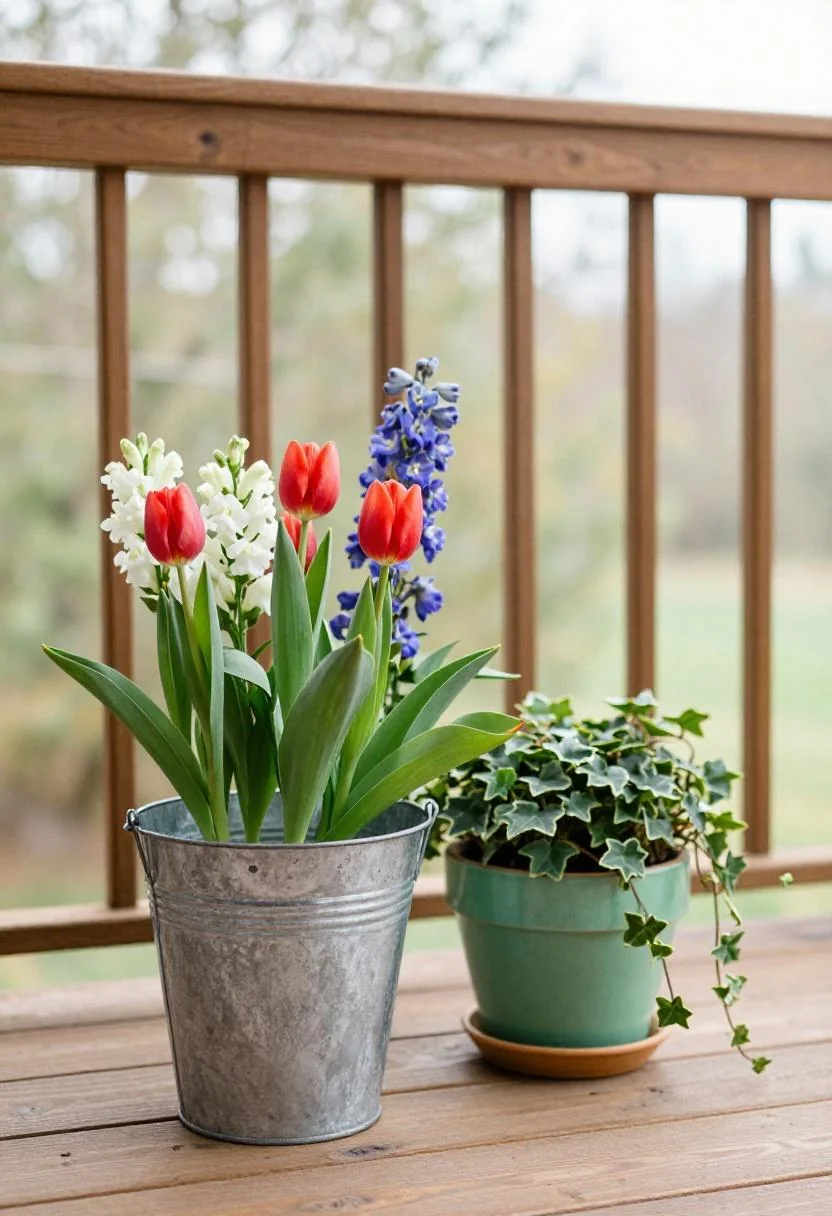
Galvanized steel has an industrial honesty that pairs better with living things than you'd expect. On a cedar deck in morning light, a bucket arrangement of red, white, and blue blooms — set beside a jade ivy pot — achieves something genuinely wabi-sabi: beauty through the combination of imperfect materials in honest context. The ivy isn't decoration. It's conversation. The two containers reference each other, different in texture and scale, unified by the green of the deck weathering beneath them.
Find galvanized planters on Amazon
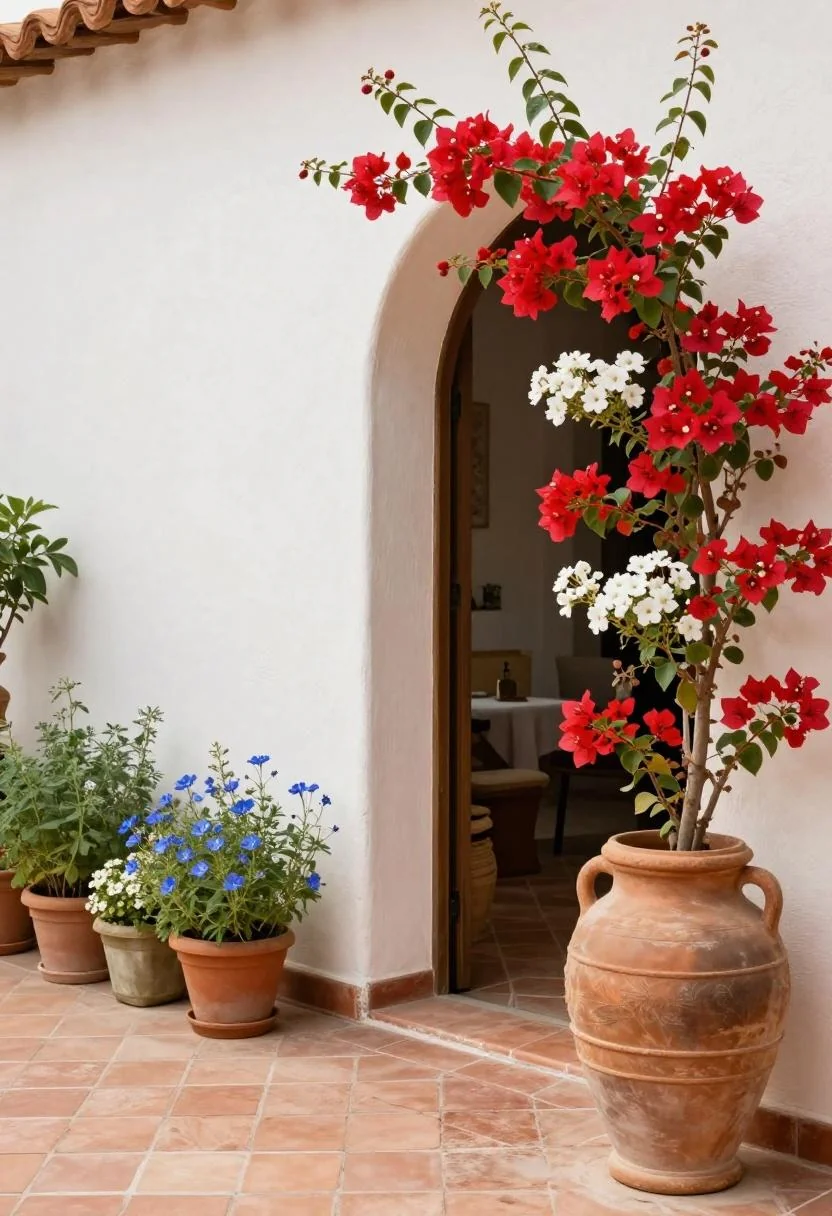
Here's where the Japandi lens catches an interesting edge: this arrangement lives beside an arched Mediterranean doorway, and the overflow is intentional abundance rather than minimalist restraint. Does it work? Yes — because the clay urn anchors it. The vessel is humble. Unglazed, rough-shouldered, rooted. The blooms can spill without the whole composition tipping into excess. Strip away the doorway and ask: would this clay urn arrangement feel right in five years? Absolutely.
What Gravel and Wood Do for Patriotic Color
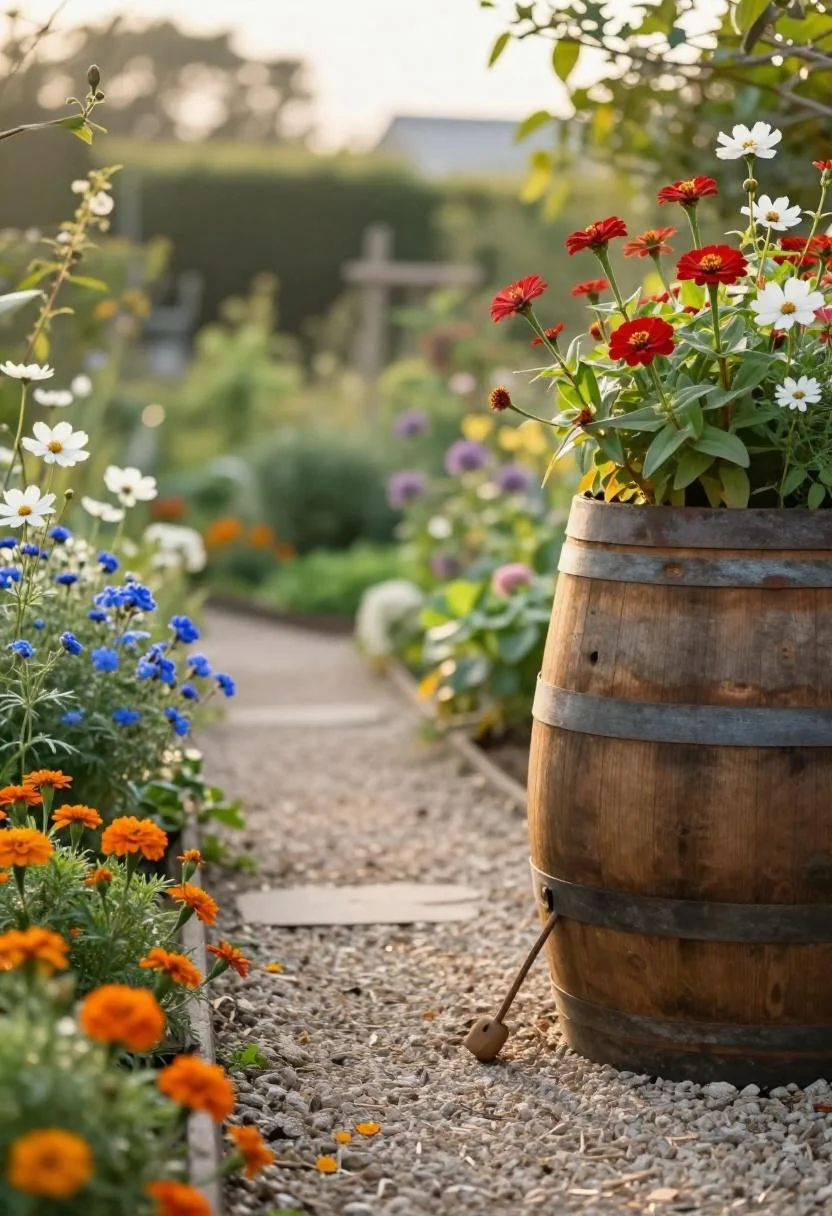
Gravel is underused as a compositional element in garden florals. Here, a wooden barrel planter sits beside a gravel path at golden hour — and the pale stone of the path creates a low-contrast base that lets the persimmon warmth of the light and the red of the blooms read cleanly without visual competition from below. The barrel's weathered wood contributes exactly the right note of age and craft. Cottage blooms — loose, slightly wild — spill over the edges. This is the kind of arrangement that looks like it happened naturally. It didn't. That's the skill.
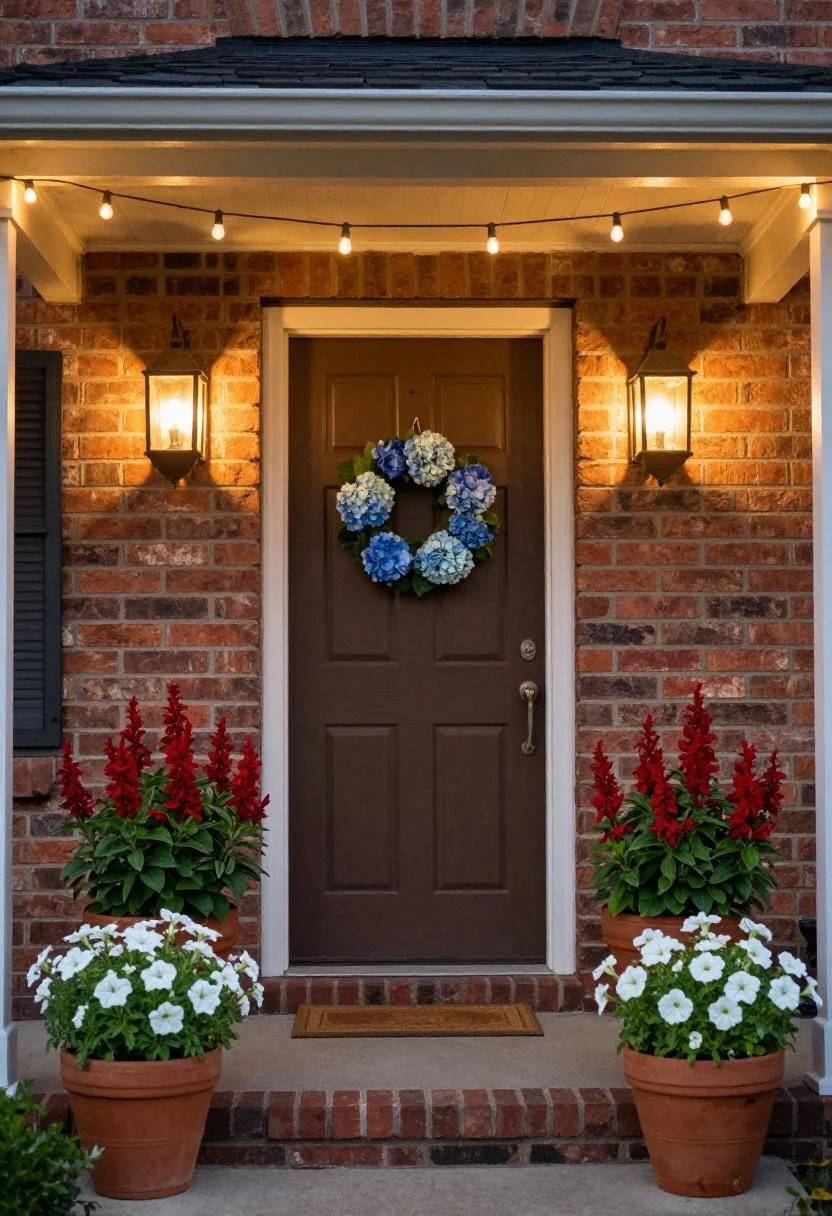
Terracotta flanking brick steps at dusk — with a blue hydrangea wreath above. The color logic is airtight: warm terracotta and brick absorb the low light; the white blooms in the pots hold luminosity; the blue wreath at the door provides the vertical anchor. Three levels, three color notes, one coherent read. Shop terracotta garden pots
The wreath here is critical — not decorative. Without it, the arrangement would read as two unrelated elements flanking a door. The wreath closes the composition. It tells the eye where to stop.
The Table as Canvas
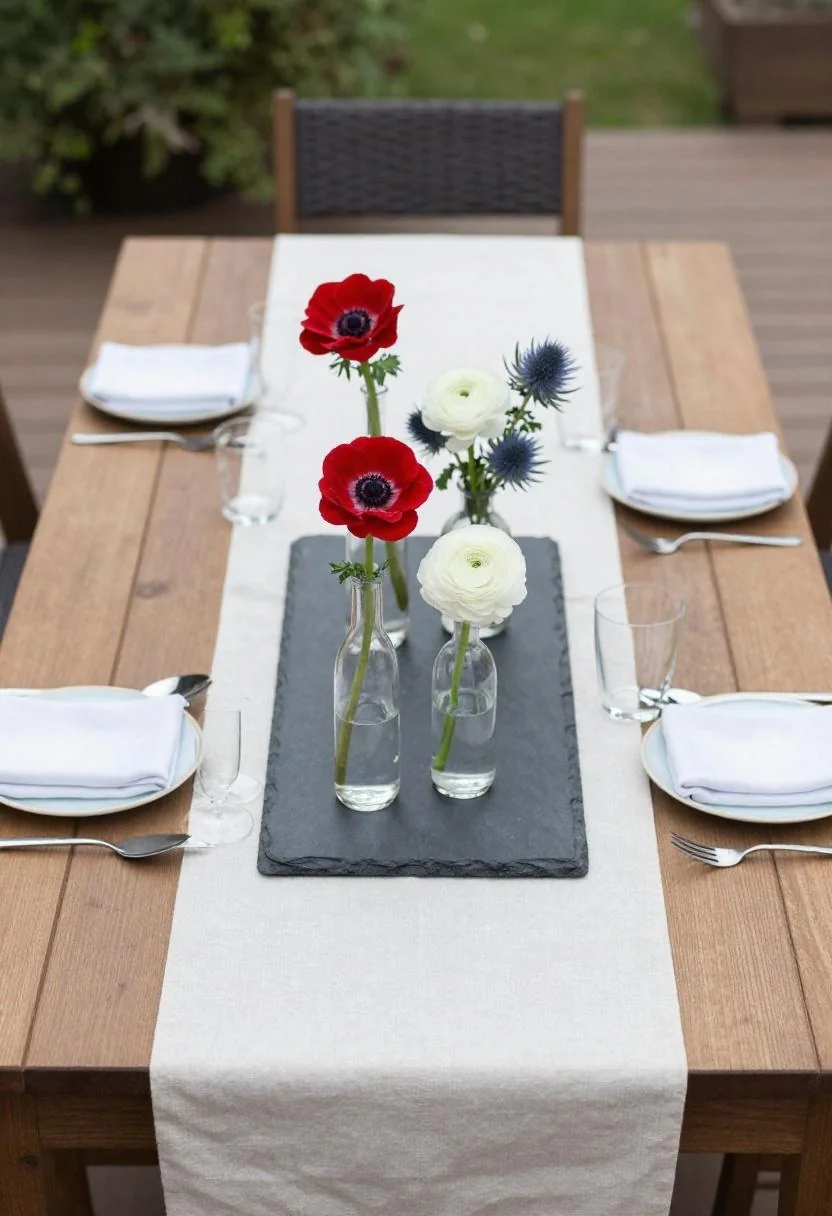
This one is the quietest arrangement in the collection — and the most Japandi. A slate tray. A cream linen runner. Bud vases, small and various, holding single stems of patriotic blooms over a teak outdoor dining table. The restraint here is the whole point. No single element shouts. The tray groups the vases without forcing uniformity; the linen softens the teak without hiding it. As Harper's Bazaar has noted in its home coverage, the move toward considered, lower-scale table arrangements is a direct response to years of elaborate centerpiece culture. This is the response.
Find bud vase sets for your table
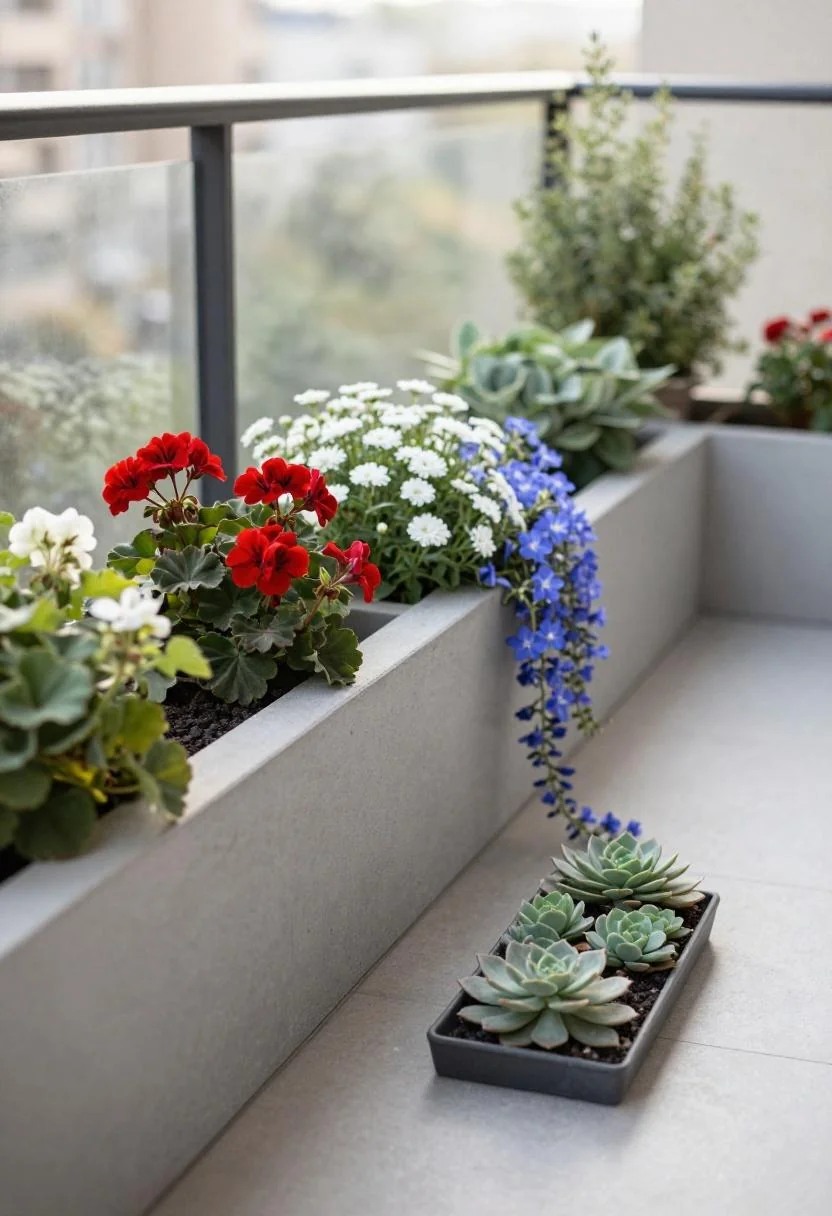
Modern balconies demand different logic than porches and garden paths. The horizontal lines are harder; the materials are less forgiving. A concrete railing planter with patriotic blooms alongside a sage succulent tray solves the problem through contrast: the blooms bring softness and color movement, the succulents bring permanence and structure. The sage green is a smart neutral here — it doesn't compete with red, white, or blue, but it grounds the whole planting so it doesn't float.
When Stone and Water Enter the Picture
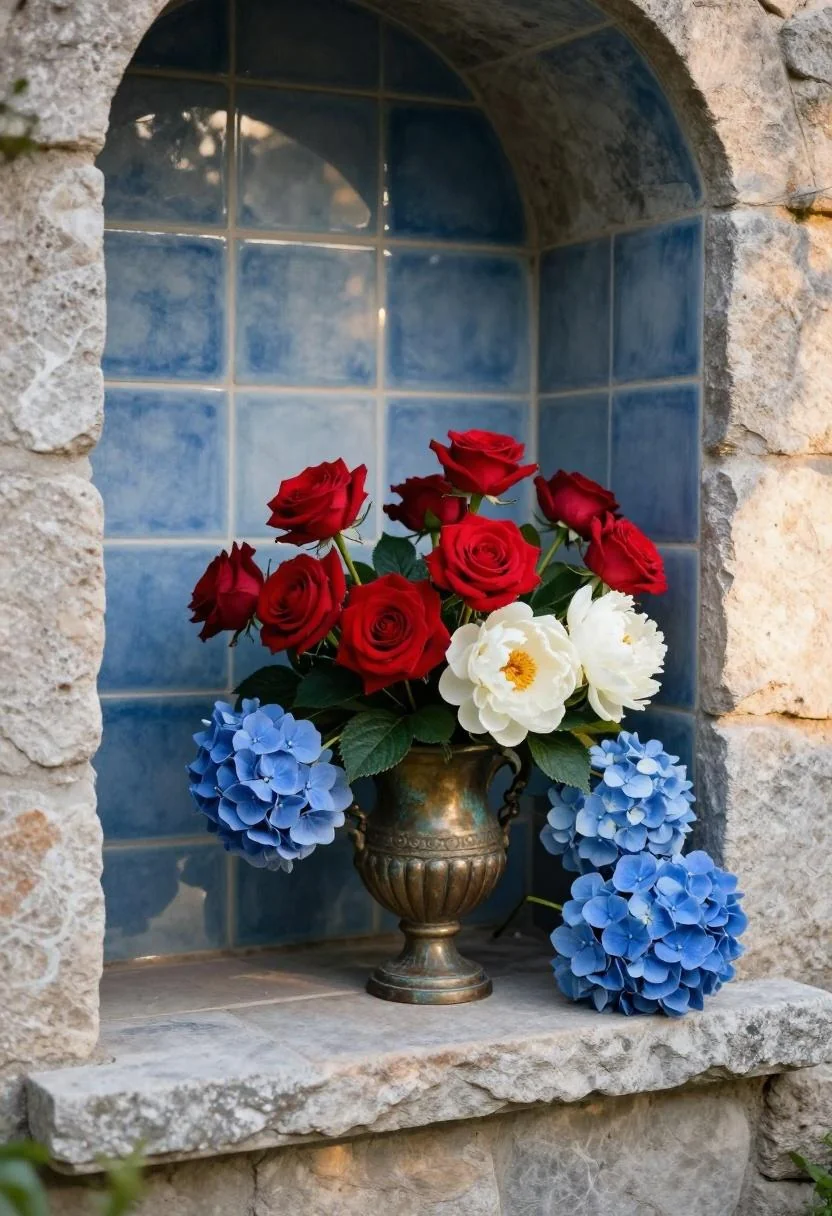
A bronze urn in a tiled stone wall niche — this is the arrangement that stops conversation. Roses, peonies, hydrangea: the patriotic palette's most lush vocabulary, held inside the cool geometry of blue tile and carved stone. The niche does the framing. You don't need a stand, a runner, or a secondary element. The architecture is the container.
It's worth asking: do you have an architectural detail in your outdoor space that could serve this function? A built-in shelf, a window alcove, a gate opening. Negative space in architecture is an invitation for arrangement.
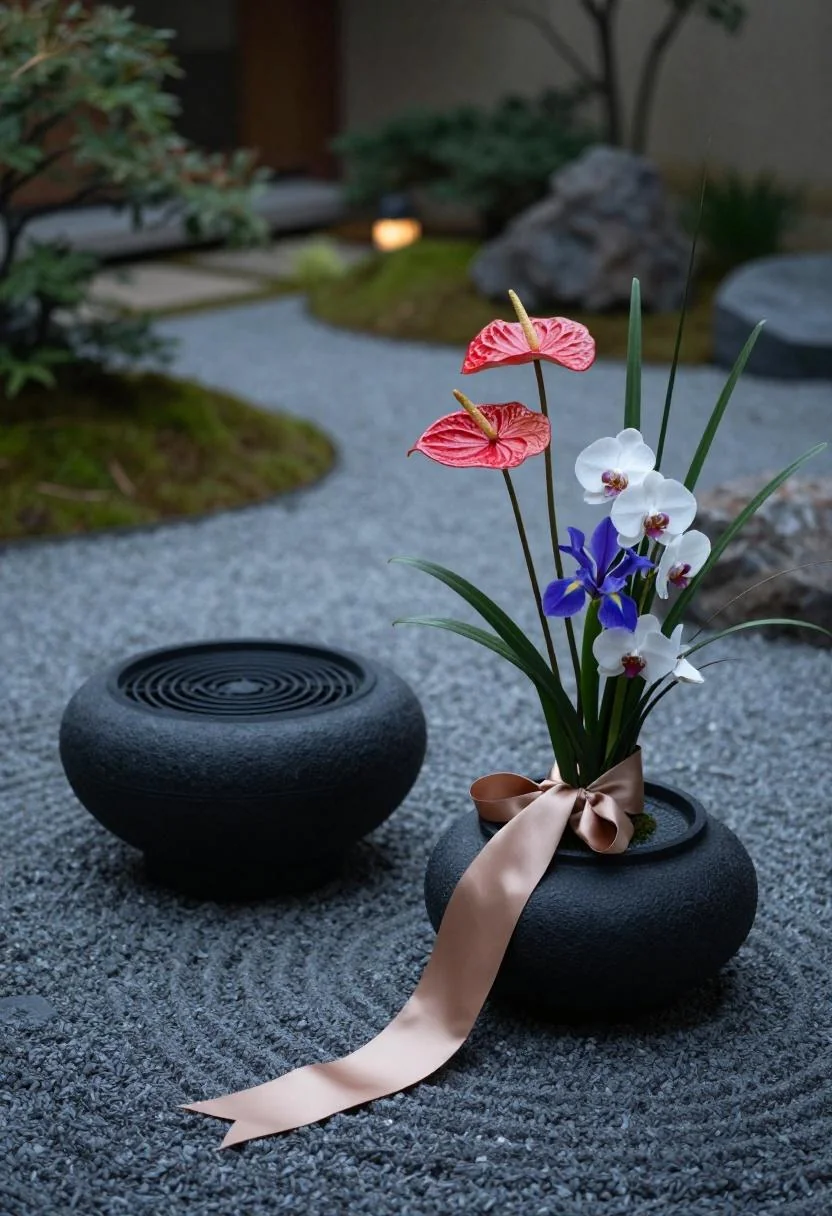
Basalt. Zen garden path. Plum silk accent. This combination shouldn't resolve as cleanly as it does — the July 4th palette feels incongruous in this setting — and yet it works precisely because the basalt vessel is so serious and so still. The florals become the only warmth in the composition, the only softness. The plum silk introduces just enough sensory richness without tipping the balance. Less noise. More intention. Shop stone vessel planters
Texture, Tropics, and the Bamboo Fence Question
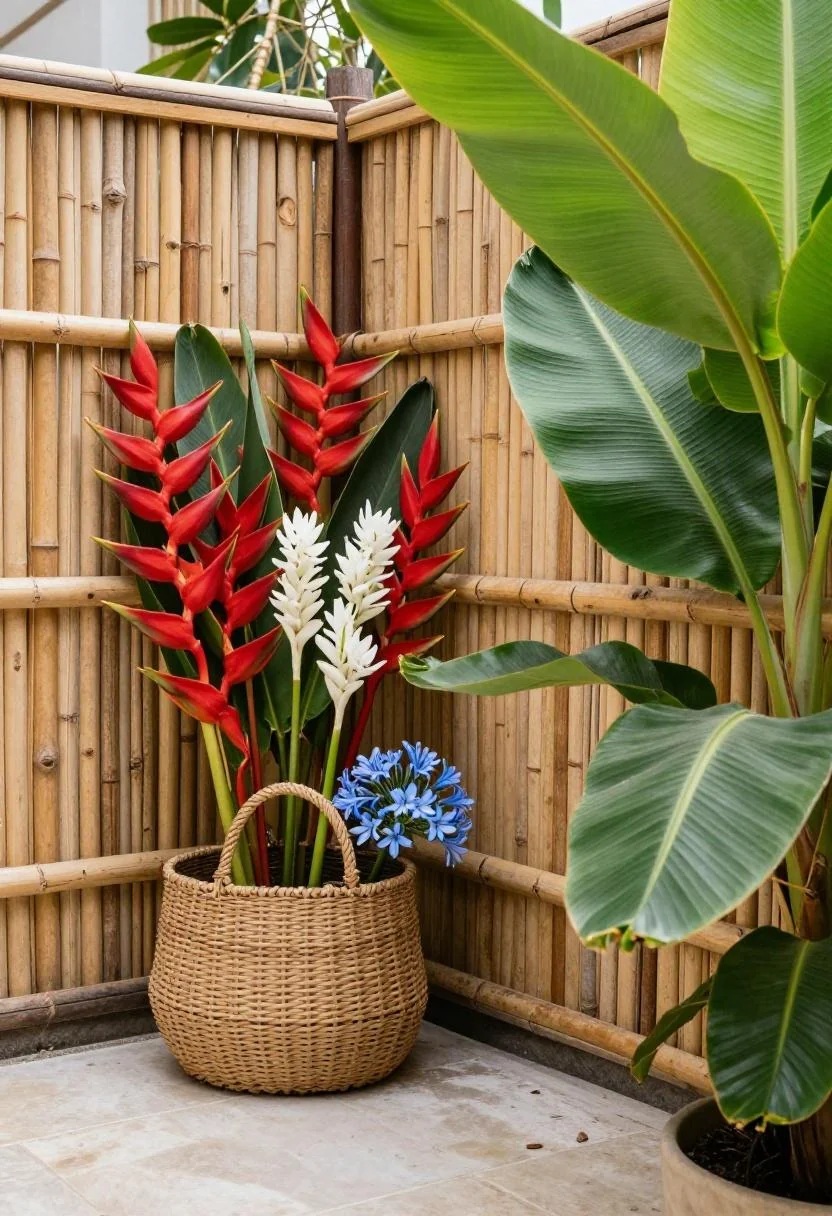
Can tropical blooms carry the patriotic palette? Against a bamboo fence framed by jade banana leaves, a rattan basket of red, white, and blue tropicals makes the case convincingly. The key is that nothing here is straining. The rattan is natural. The bamboo is natural. The banana leaves are natural. Into that consistently organic context, the blooms arrive as color — saturated, confident — without needing to explain themselves. If you're interested in how fencing can function as a design element beyond structure, our guide to wooden fence decorating ideas explores this in depth.
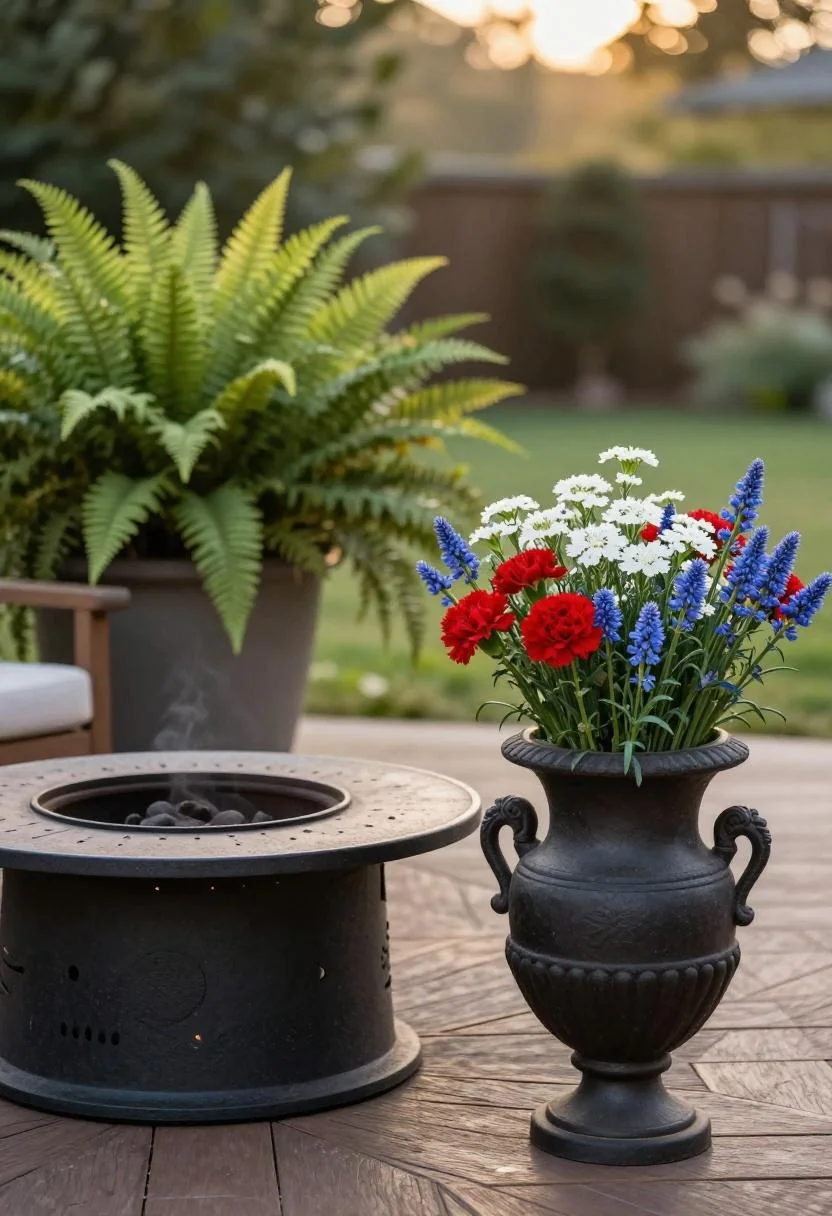
A cast-iron urn beside a fire pit, wasabi ferns massed behind it in golden hour — this is the arrangement that rewards patience. You won't see it at its best at noon. Wait until the light goes amber and the shadows lengthen, and then the whole composition changes register. The iron weight of the urn, the warmth of the fire pit's stone, the acid green of the ferns — these create a frame that makes the patriotic colors feel earned rather than expected. Find cast-iron urns on Amazon
Windows, Shutters, and the Cottage Instinct
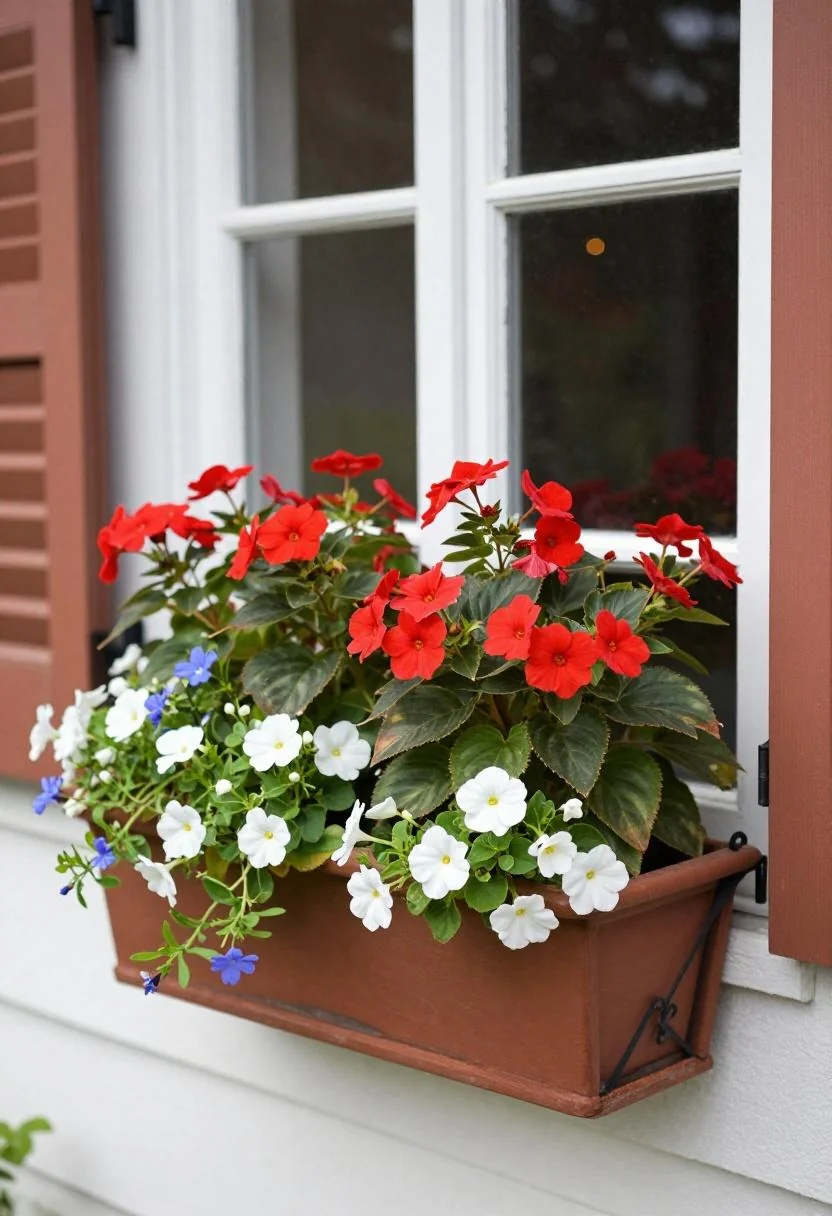
Window boxes are the most forgiving format in outdoor florals — they're contained by definition, visible from inside and outside, and they don't require a table or surface. This cedar box, dense with patriotic blooms and flanked by persimmon shutters, achieves exactly what cottage-style arrangements at their best always do: it makes the architecture feel inhabited and loved without overwhelming it. The persimmon shutters — that warm orange-red — pick up the bloom color without duplicating it. Proximity without repetition.
Dense planting is a decision here, not an accident. Where wabi-sabi sensibility usually favors negative space, the window box is one format where abundance is structurally appropriate — the frame holds it.
Earth, Mosaic, and the Wildflower Argument
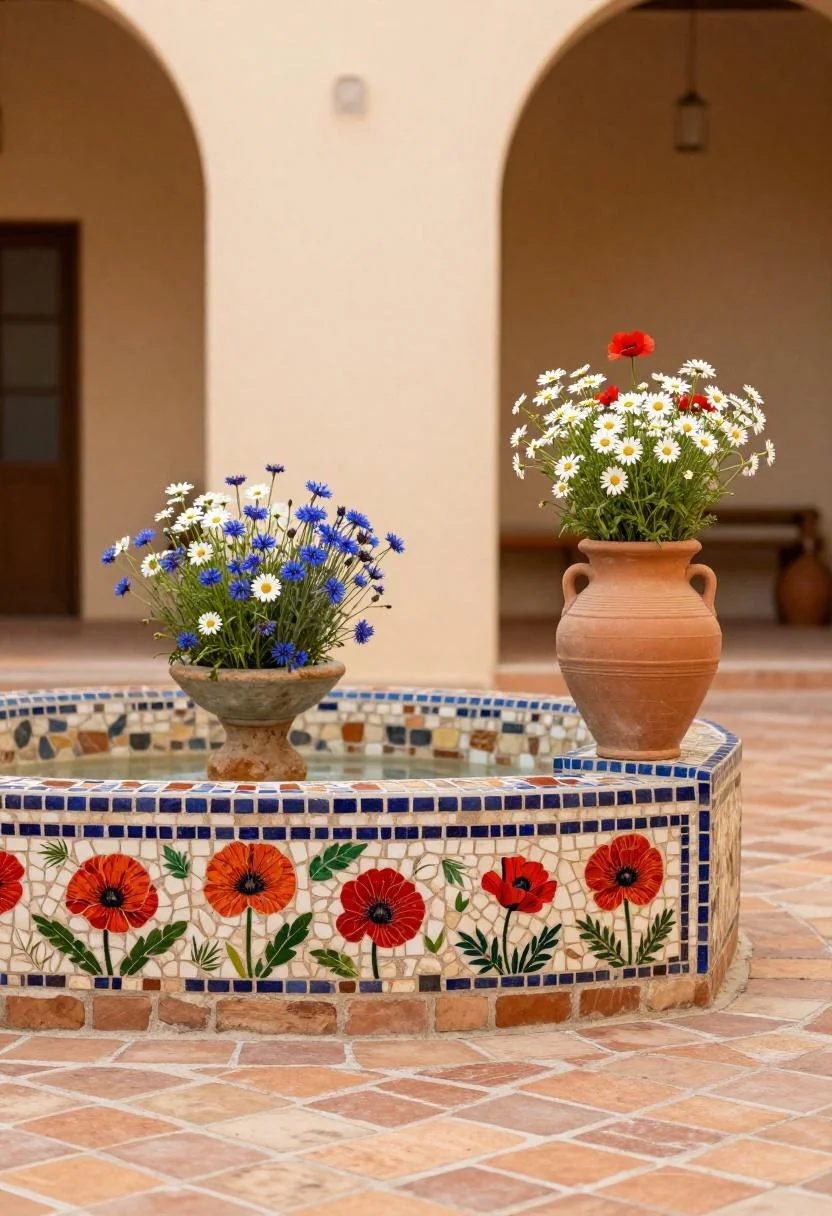
Wildflowers in an earthenware urn. A mosaic fountain. Warm terracotta cobblestones beneath. This is the arrangement that argues most forcefully for looseness over precision. Wildflowers resist arrangement in the formal sense — they have their own opinions about direction and height. Working with that rather than against it produces something that feels like it grew rather than was placed.
The mosaic fountain is doing heavy compositional lifting in the background, providing pattern and color complexity that would overwhelm a more structured floral — but which the wildflower arrangement meets with equal visual energy. The earthenware grounds it all. Shop earthenware garden urns
The Evening Arrangement — String Lights and Linen
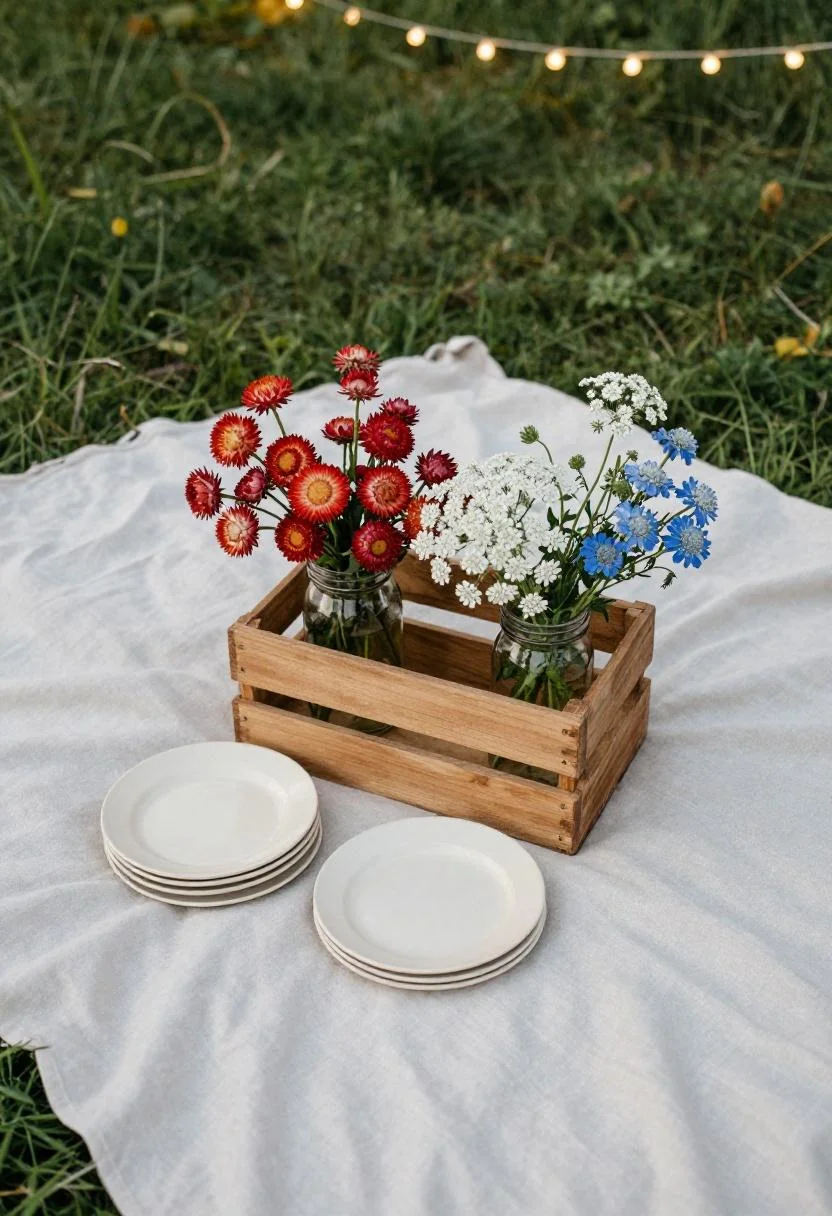
The last arrangement is the most informal and — in the right context — the most affecting. A wooden crate of mason jar florals, each jar holding a small patriotic cluster, set on a cream linen picnic blanket at dusk under string lights. The light from the strings warms the whites, deepens the reds, and gives the blues a richness they don't have in daylight.
This is hospitality in its most unguarded form. It's not trying to be impressive. That's exactly why it is. For more ways to design your summer outdoor spaces with intention, see our guide to summer front door decor ideas.
How to Get the Look: A Few Honest Notes
Choose your vessel with the same care as your blooms. Concrete, basalt, cast iron, earthenware, rattan — each sets a completely different emotional tone. Buy the container first, then select flowers that respond to it.
Time your arrangement to the light. If you're creating for a golden-hour gathering, build the arrangement in that light. Colors behave differently at different times of day, and patriotic palettes are especially sensitive — flat midday light can make them look primary-school flat.
Use a secondary color to do the contextual work. Plum linen, jade ivy, sage succulents, wasabi ferns — in almost every arrangement above, a secondary color prevents the red/white/blue from reading as a costume. Pick one and commit to it.
Negative space is not empty space. A single earthenware urn on a wide terracotta terrace — the cobblestones and open air around it are part of the composition. Resist the impulse to fill every surface.
Making It Your Own
What these fifteen arrangements share isn't the palette — it's the commitment to materiality. Every one of them is built around a vessel with honest texture, placed in a setting that acknowledges its surroundings rather than ignoring them. The blooms change. The vessels change. The light changes. The approach stays consistent: let the thing be what it is.
Red, white, and blue don't require nostalgia or spectacle to work. Strip away the expectation and ask what's actually there: three colors with strong individual personalities and real relationships with light, texture, and negative space. As Elle has long argued, the most lasting home aesthetics aren't seasonal — they're material. Build the arrangement around something real, and the colors will follow.
The Fourth of July passes in a day. A well-chosen ceramic urn or rattan basket stays in your garden for years. Buy for the vessel. Let the holiday be the occasion.
And if the urge to go further with your summer outdoor aesthetic doesn't stop at flowers — it rarely does — our roundup of rustic arbor ideas for a dreamy garden entrance shows how the same material sensibility scales up.
This post contains affiliate links. We may earn a commission at no extra cost to you.
Images in this article were created with AI assistance.


