There's something quietly powerful about a well-dressed fence. Not the fence itself — the lumber, the posts, the hardware — but what you do with it. The classic American backyard has always treated the fence as a boundary, a border, a thing that simply exists. But homeowners with an eye for the traditional and the timeless have long known better. A fence is a canvas. A long, sun-weathered, perfectly positioned canvas that faces your garden every single day.
This isn't about slapping a few hooks on cedar boards and calling it a day. The decorating ideas here draw from a design tradition that values symmetry, patina, natural materials, and the kind of layered beauty that looks like it accumulated over generations — even when you pulled it off last Saturday for under $150. Think estate gardens. Think cottage courtyards. Think the backyard of someone who actually has a favorite antique shop.
Pro tip — the biggest mistake most DIYers make is treating the fence as an afterthought. You spend three weekends on the garden beds, source the perfect pavers, and then hang a single sun ornament on the fence and call it done. Don't. The fence deserves the same intentional layering you'd give a gallery wall inside.
Start With a Planter That Commands Attention
Mounted planters are the single fastest way to make a fence feel intentional. Not decorative — intentional. There's a difference. When you see a row of matching metal planters anchored at eye height, with trailing herbs spilling over the edges, you know someone thought about it. That symmetry — that deliberate repetition — is what separates classic garden design from casual.
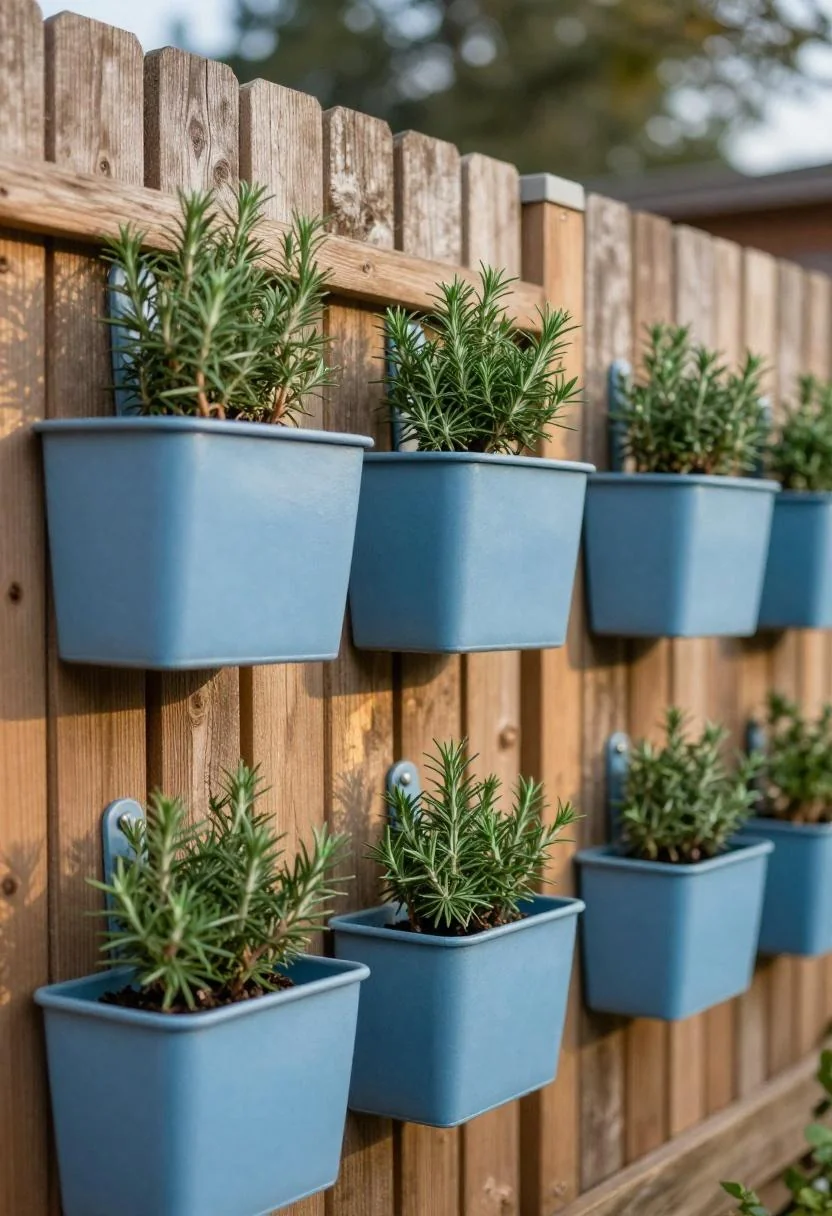
Cool blue metal planters with rosemary trailing over cedar — the afternoon light does half the work.
These cool blue metal planters are doing something elegant: the color reads almost like aged copper or old French ironwork, especially against warm cedar tones. Rosemary is the right plant choice here — it's structured, aromatic, and frankly looks more expensive than it is. Mount three or five of these (odd numbers, always), space them evenly, and you've got a garden vignette that would look at home in a Provençal estate. Shop blue metal wall planters on Amazon.
Here's the trick with fence mounting: use exterior-grade screws and pre-drill. Nothing ruins the look faster than a planter that's tilting six months later because the wood swelled in winter.
The Case for Wrought Iron — Even on a Cottage Fence
Wrought iron and climbing roses. Is there a more classically English combination? Probably not. But here's what's interesting — that combination works just as well on a modest cottage fence as it does on grand estate gates, because the materials carry the visual weight themselves.
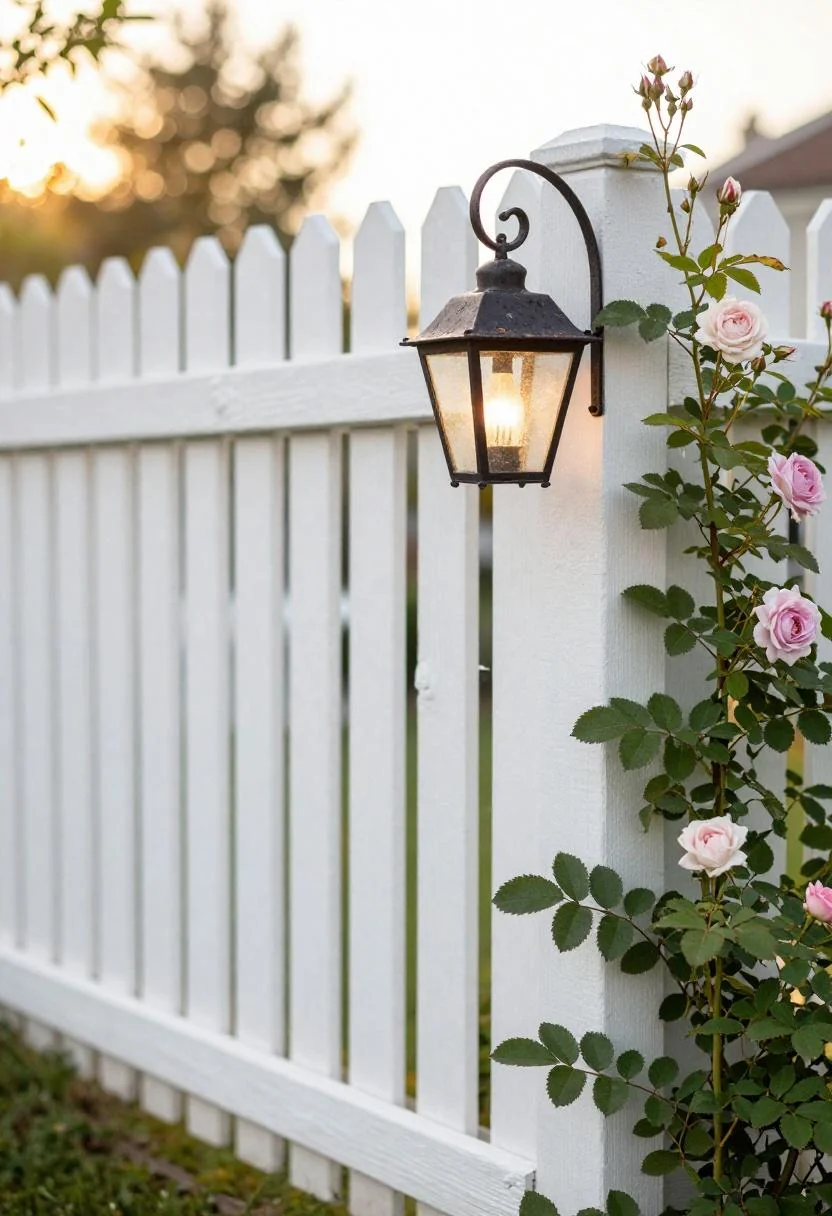
A plum noir wrought-iron lantern at golden hour — this is what 'atmosphere' actually looks like.
This plum noir lantern is doing serious lifting here. The dark finish reads as almost black in shadow, then reveals that deep eggplant undertone when the golden hour light hits it directly. Hung from a simple fence post hook amid climbing roses, it creates the kind of moment that took zero skill to install but looks like you planned it for years. Real talk: lantern hooks cost about $8 at the hardware store. This whole vignette is a Saturday morning project.
The mistake most beginners make is choosing a lantern that's too small. Scale up. A fence post can handle a lantern that seems almost too large in the store — and outside, in actual proportion with the yard, it'll be exactly right. As Elle Decor has consistently noted in their outdoor design coverage, undersized accessories are the most common error in garden styling.
Vertical Greens: The Bamboo Fence Wall Garden
Bamboo fencing has an unfair reputation as a purely contemporary or tropical element. Not true. When you anchor it with traditional ceramic pieces — especially in classic glaze colors — bamboo becomes a quiet backdrop, almost like linen.
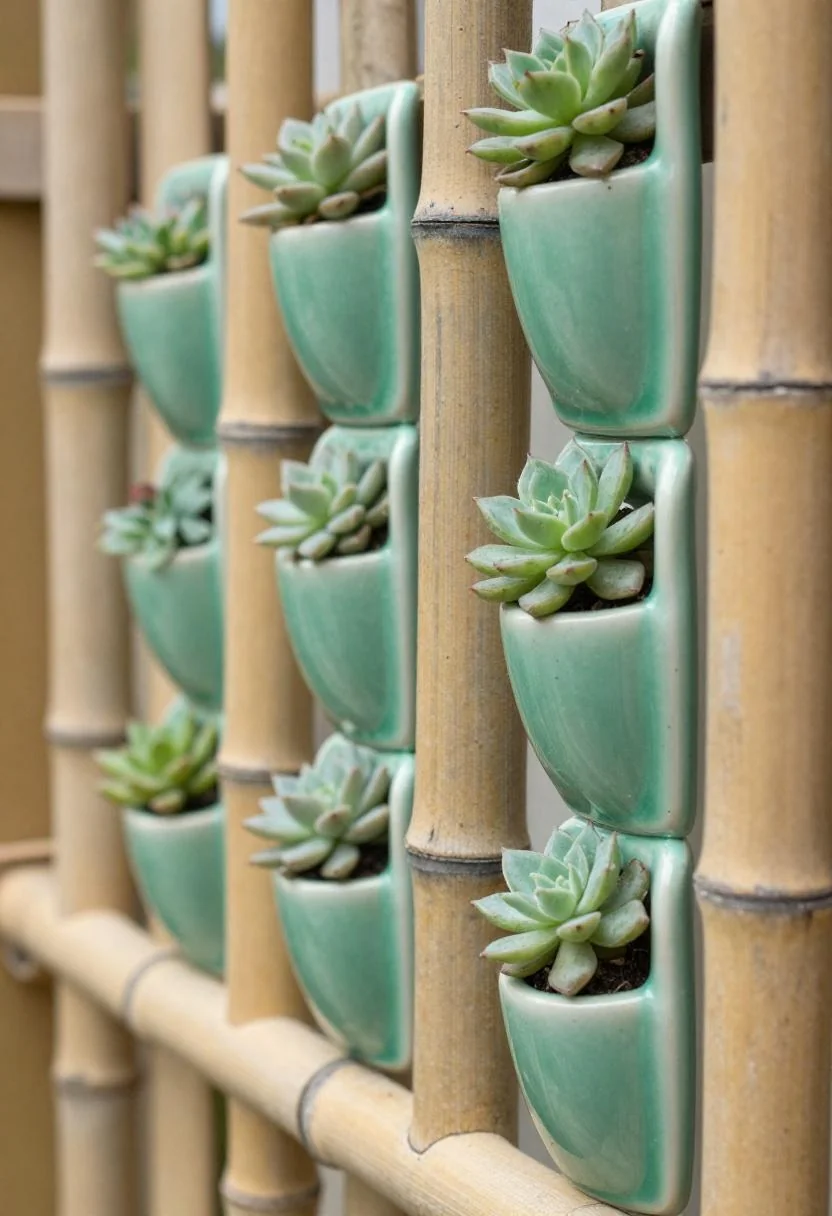
Jade green ceramic wall pockets on bamboo — the vertical arrangement gives the whole fence a sense of architecture.
These jade green ceramic wall pockets arranged vertically pull off something clever: they turn the fence plane into a vertical garden without requiring any special irrigation or structural modification. Succulents are the practical choice — they tolerate neglect, they propagate easily, and the rosette forms in that jade-on-jade color story are genuinely beautiful up close. You can pull this off in a weekend for under $80. Buy the pockets in a set, use a level and painter's tape to mark your spacing before you drill a single hole, and plant with a well-draining cactus mix.
If you're working with a smaller fence section, concentrate the arrangement rather than spreading it thin. Three pockets clustered in a triangular arrangement reads as a design choice. Three pockets spread five feet apart reads as indecision.
The Anchor Planter: Ground-Level Drama
Not everything has to be mounted. Sometimes the most effective fence decoration sits on the ground.
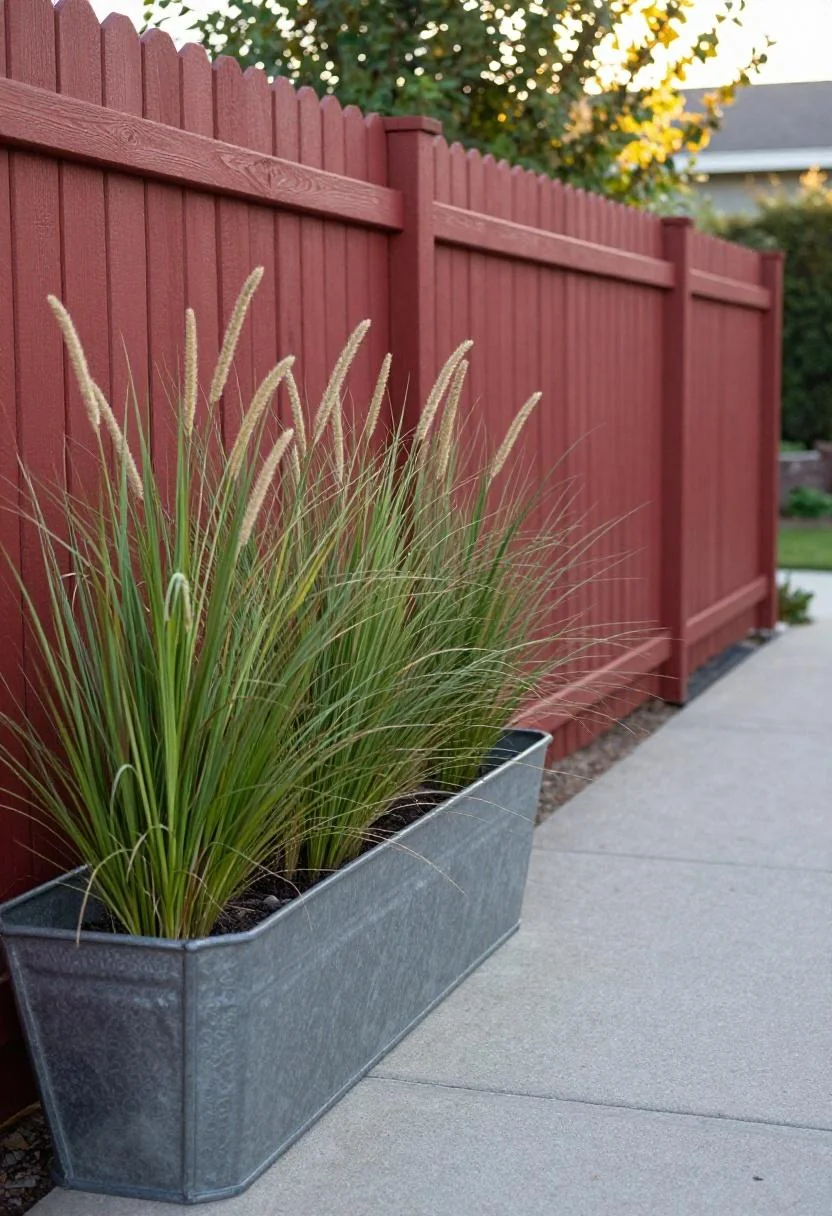
Wasabi galvanized trough at the fence base — ornamental grasses planted here move beautifully in any breeze.
A galvanized trough planter in this wasabi tone (somewhere between sage and chartreuse — more interesting than either) anchored at the base of a redwood fence does exactly what a good plinth does in architecture: it grounds the vertical element. Ornamental grasses are ideal because their movement creates life in the static composition. Japanese forest grass, blue oat grass, or purple fountain grass all work well and come back reliably year after year in most climates. Find galvanized trough planters on Amazon.
For a traditional look, pair the trough with a redwood or cedar fence that's been treated with a semi-transparent stain rather than painted — the wood grain showing through adds texture that solid paint eliminates. Our guide to best Sherwin Williams deck stain colors covers the best semi-transparent options if you're also working on the fence stain decision simultaneously.
Window Boxes Are Not Just for Windows
Somewhere along the way, window boxes got confined to, well, windows. What a waste.
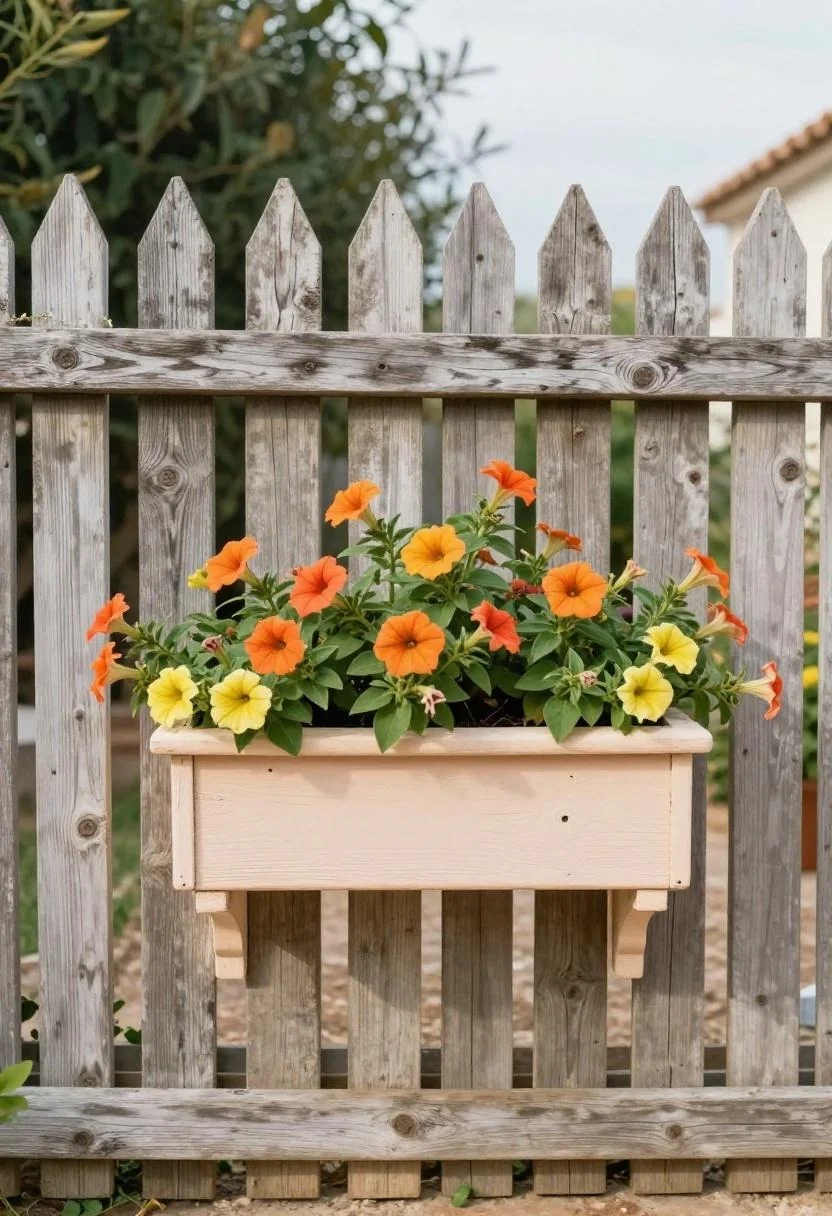
A persimmon bracket and petunias on a weathered oak fence — the Mediterranean reference is subtle but clear.
This persimmon window box bracket mounted on a weathered oak fence leans hard into Mediterranean vernacular — the rough timber, the trailing petunias, the warm amber-orange hardware color against sun-bleached wood. It's a combination that shows up on terraced village walls across southern Europe for a reason: it works. The bracket is doing double duty here, adding color at the mounting point itself rather than just functioning as invisible hardware. If you're drawn to Mediterranean design more broadly, our Mediterranean villa style design guide goes deep on how to carry these ideas through an entire property.
For the DIY execution: window box brackets are widely available, but painting a standard bracket in persimmon (try Rust-Oleum in Sunrise — it's close) costs about $6 in spray paint and makes the bracket itself a design element.
String Lights and Clay: The Evening Transformation
Some fence looks are all-day. This one earns its keep after dark.
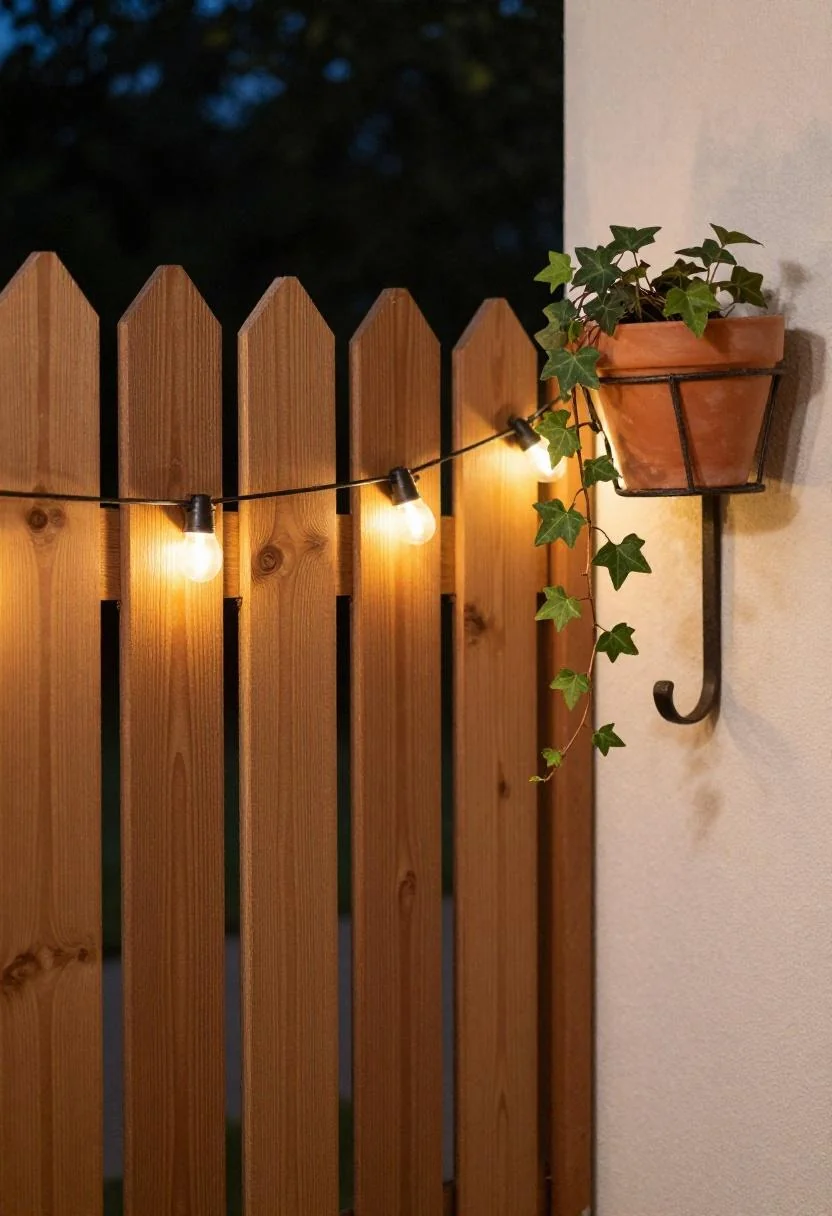
Terracotta and string lights at dusk — the ivy adds movement, the lights add warmth, and it costs almost nothing.
Terracotta has been a garden staple for centuries, and for good reason: it ages beautifully. That warm orange-red darkens at the rim where water sits, develops mineral streaks over the seasons, and acquires a patina that no manufactured "aged" finish ever quite replicates. Hung here on a pine fence with trailing ivy and backed by string lights, the pot becomes a lantern of its own — the clay glows in the warm light. This is an evening-use decoration more than a daytime one, but in a backyard where you actually spend time after dinner, that distinction matters enormously. Outdoor string lights on Amazon — don't scrimp here, the warm-white versus cool-white distinction is dramatic in person.
When Less Is the Point
Here's a design principle that takes practice to trust: restraint is a choice, not a failure to decide.
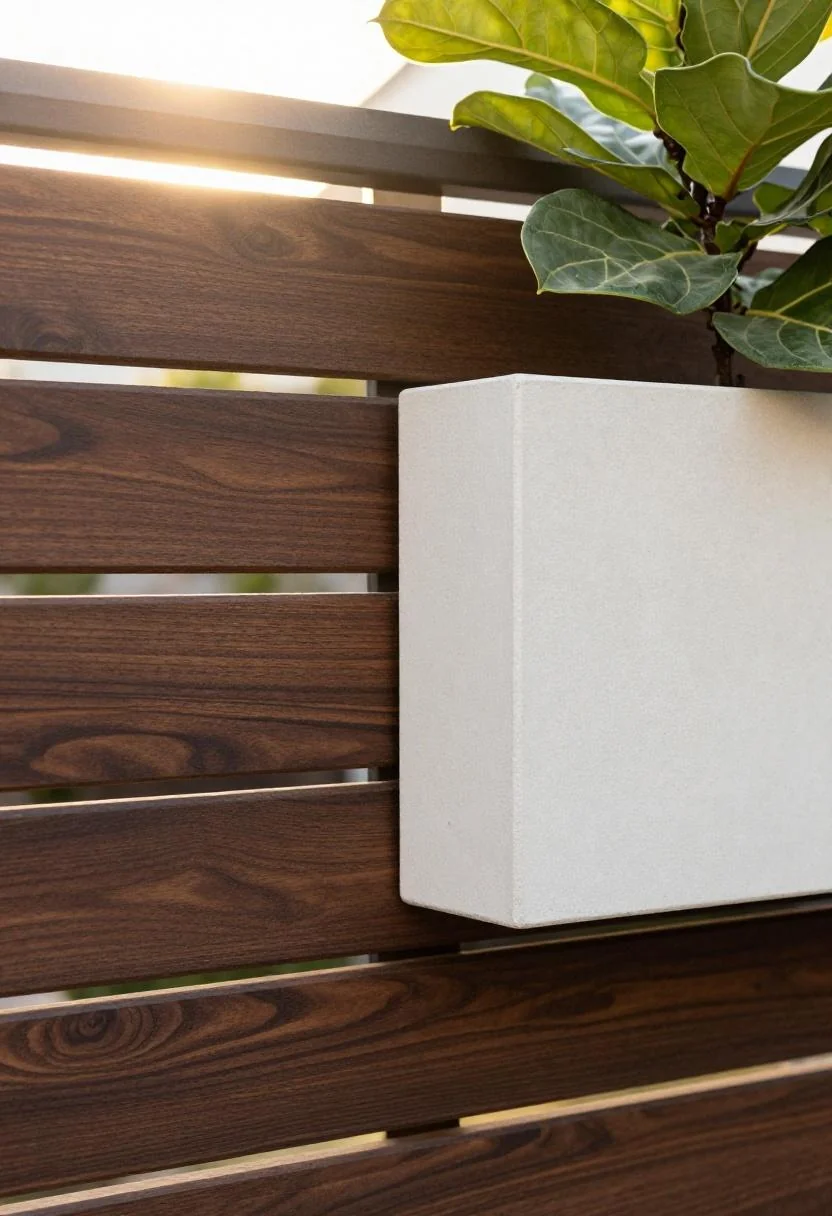
One pothos. One cream white shelf. One beautiful decision.
A single concrete shelf, cream white, mounted on a walnut fence with a single pothos trailing over the edge — this is not an unfinished idea. This is a complete idea. The walnut fence itself is doing the heavy decorative lifting here (that timber is gorgeous, and someone made a serious commitment to it), and the shelf and plant function as punctuation, not content. If you have a fence material or wood tone you're proud of, this approach shows it off rather than covering it up.
The mistake most beginners make with minimalist fence decoration is adding "just one more thing" until it's no longer minimal at all. Commit. One object. Let it breathe.
The Zen Corner: Stone, Ceramic, and Intention
A dedicated meditation or zen corner in the yard doesn't require an overhaul. It requires a fence section, a few well-chosen pieces, and a commitment to leaving that corner alone — not crowding it with more, not using it as overflow storage when the patio fills up.
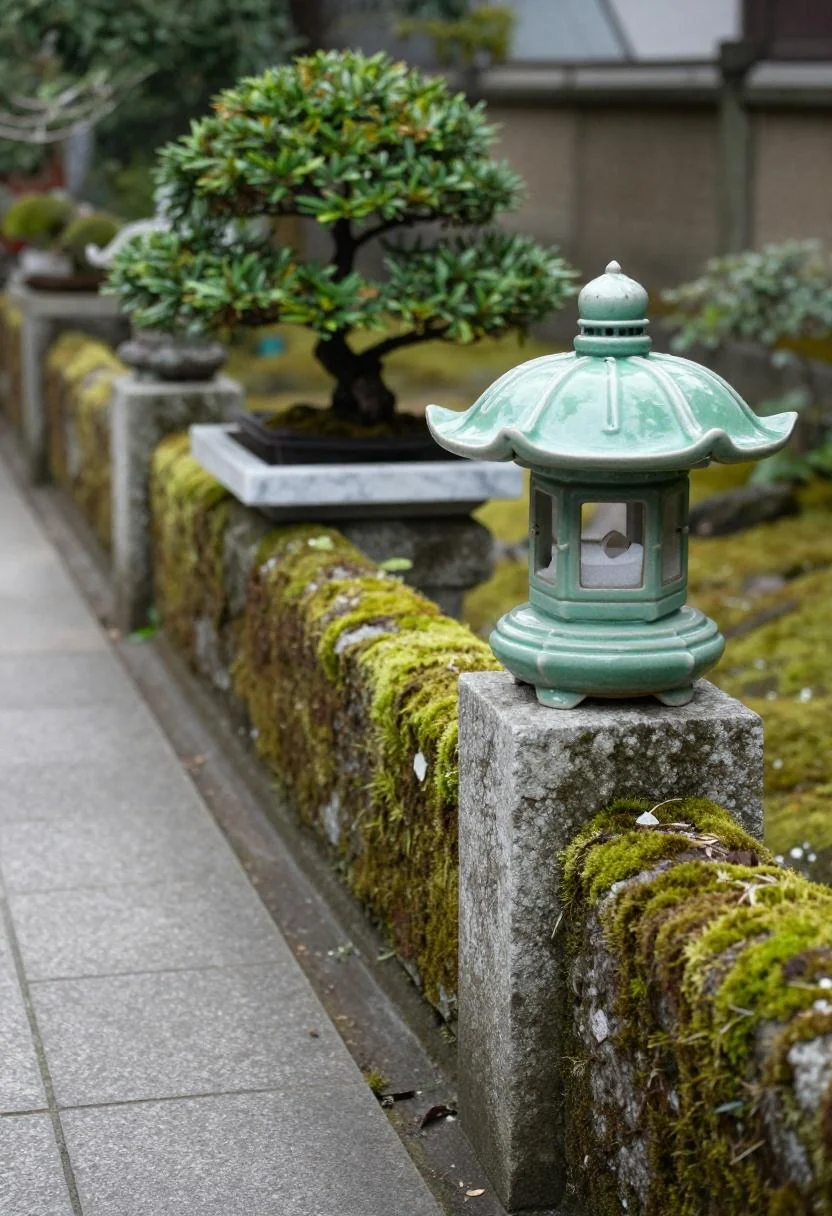
Sage green ceramic lantern and a marble bonsai tray — this corner asks you to slow down for a second.
The sage green ceramic lantern here has a beautiful glaze quality — matte, slightly uneven, unmistakably hand-finished. Paired with a marble bonsai tray on a stone fence post, the arrangement reads as a traditional Japanese garden vignette that also happens to work within a Western backyard context. The restraint of two objects is what makes it function. Sage green ceramic outdoor lanterns on Amazon.
Do you have a corner of your yard that currently collects forgotten pots and tangled hoses? That's the corner that needs this treatment most.
Morning Light and the Simple Bucket
Not every decoration is a project. Some are just a choice made in five minutes that lasts all summer.
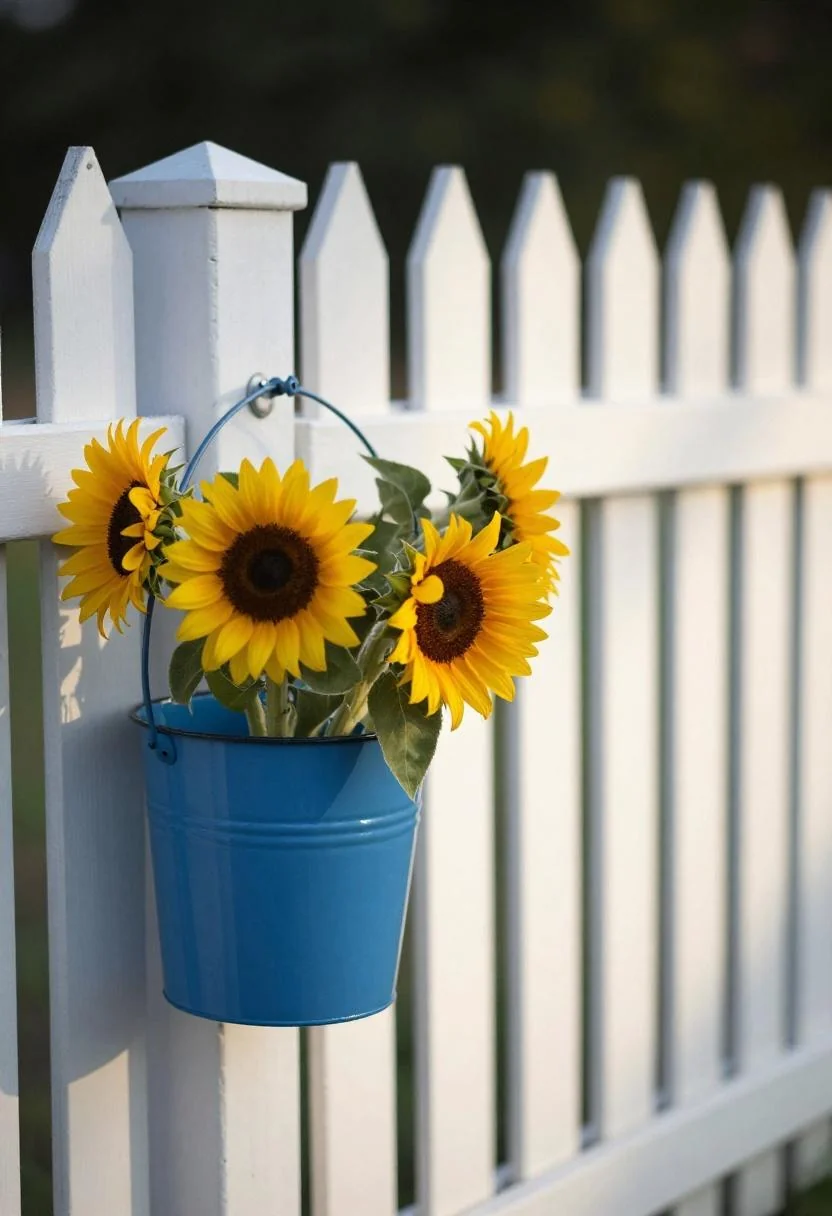
Morning sun on sunflowers in a cool blue enamel bucket — genuinely can't get more cheerful than this.
This cool blue enamel bucket filled with sunflowers, hung from a split-rail pine post in morning sun, is so simple it almost seems like it doesn't count. It counts. Enamelware buckets are inexpensive, they come in dozens of traditional colors, and a fresh bunch of sunflowers from the farmers' market costs $6. What makes this work is the proportion — a bucket rather than a small vase, sunflowers rather than delicate florals. The scale matches the fence. That's the whole secret.
The Mirror Trick — Outdoors
Interior designers have used mirrors on walls to expand perceived space for centuries. The same principle applies outside, and it's dramatically underused in backyard design.
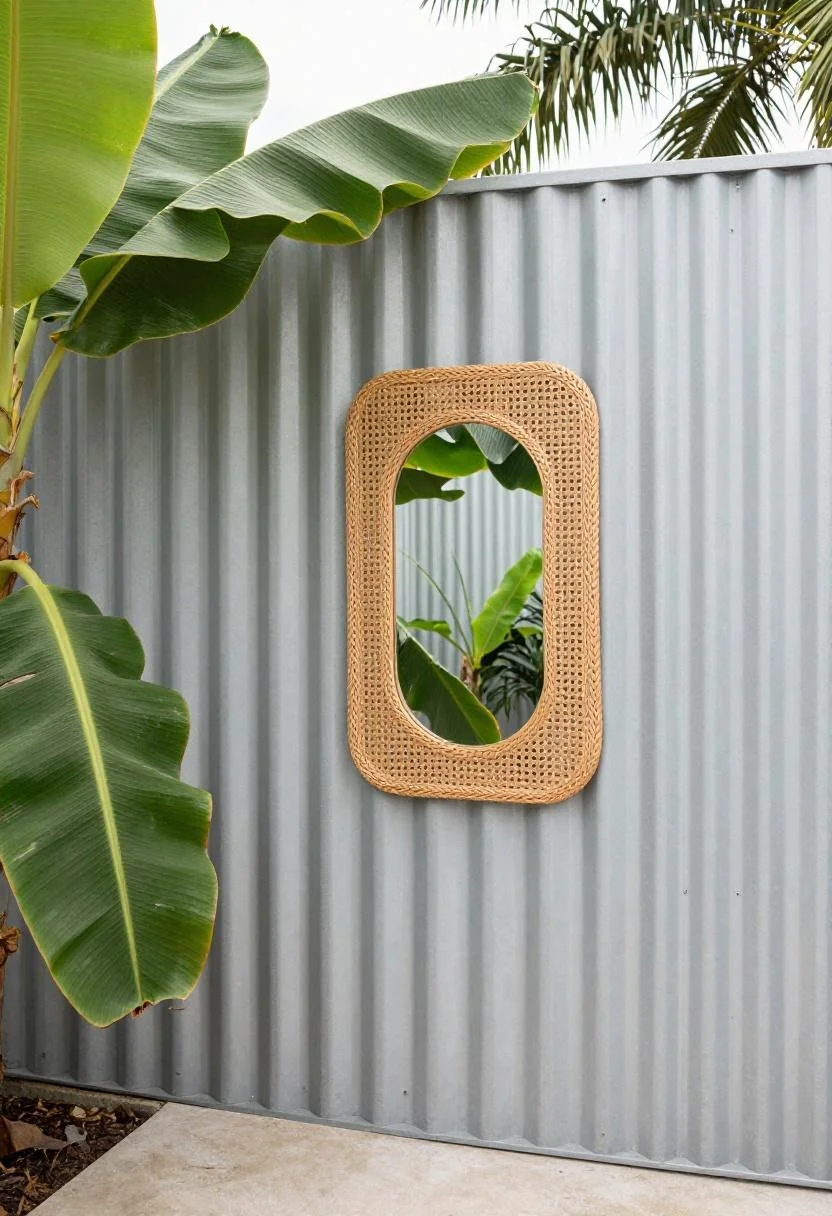
A rattan mirror on corrugated steel — the tropical palm in front doubles visually and the effect is slightly theatrical.
This plum noir rattan mirror on corrugated steel with a banana palm in the foreground is doing something genuinely interesting: the mirror reflects the palm, and suddenly you have the impression of a lush, deep garden rather than a contained backyard. The dark plum tone of the rattan frame keeps the piece from reading as purely beachy or tropical — it has a gravity to it. As Harper's Bazaar has pointed out in their home and garden coverage, outdoor mirrors are one of the fastest ways to shift the perceived scale of an outdoor space.
Use only mirrors rated for outdoor use or specifically sealed for moisture. Standard mirror backing corrodes outdoors and the effect goes from elegant to ruined in one rainy season — ask me how I know (the back patio, 2022, a perfectly beautiful mirror reduced to spotted disaster by October).
Ceramic Tile Plaques: The Heirloom Touch
There are fence decorations that look nice. And then there are fence decorations that look like they were collected over time, brought back from travels, or inherited from someone with taste. Ceramic tile plaques fall into the second category — and they're more achievable than they appear.
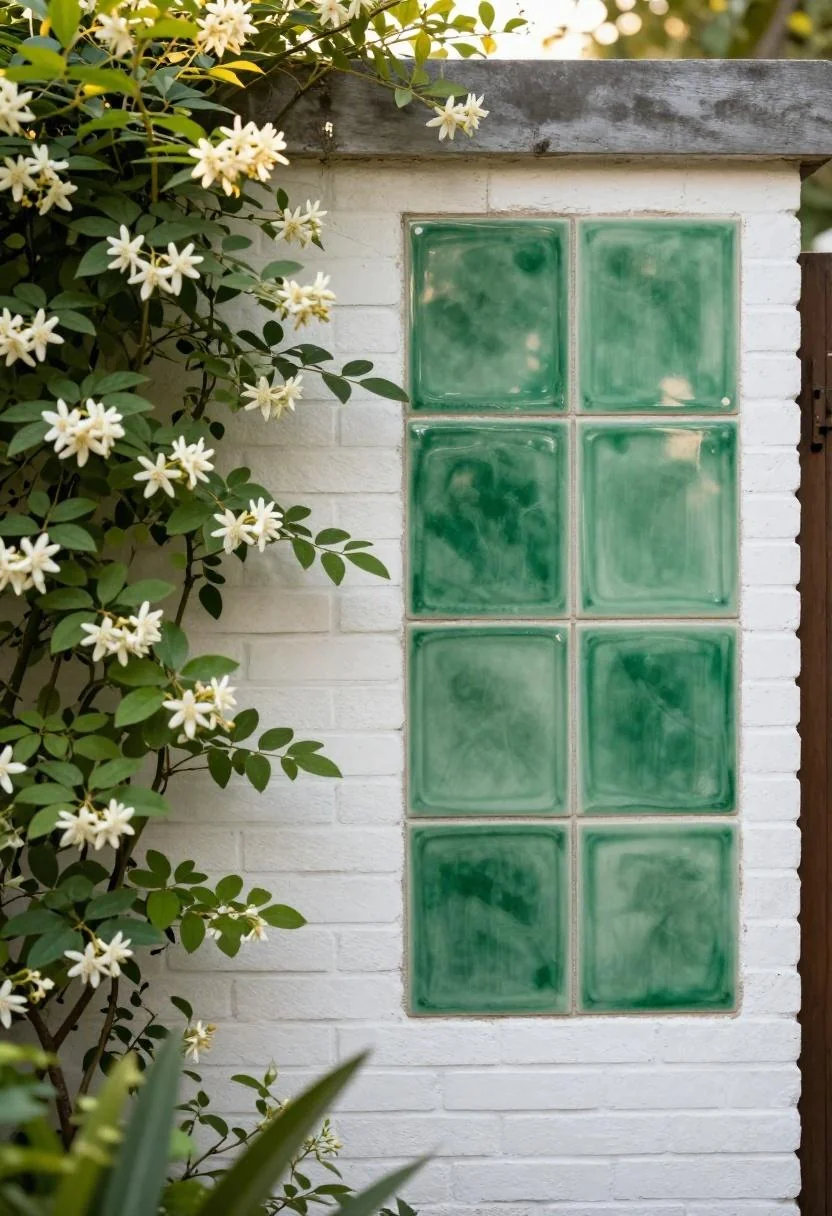
Jade green tile plaques on whitewashed brick with jasmine — this arrangement looks like it was assembled over a decade even if it wasn't.
These jade green ceramic tile plaques arranged on whitewashed brick, framed by golden hour jasmine, are the backyard equivalent of a gallery wall. The asymmetric arrangement, the varied sizes, the way the tiles catch different angles of light depending on their glaze depth — this is layering done right. Jasmine is the ideal companion plant for this kind of wall decoration because its growth habit fills gaps organically rather than competing with the tiles for attention. Outdoor ceramic tile plaques on Amazon.
If you're sourcing these gradually — which is the right approach — look at estate sales, import shops, and Mediterranean-style garden centers. The mix-and-match quality of a curated tile arrangement is impossible to replicate with a single matching set, and it's much more honest to the traditional aesthetic this kind of decoration draws from. Our half barrel planter ideas article pairs well with this approach if you're building out a full garden vignette around the same fence section.
Outdoor Seating as Fence Decor? Yes, Actually.
The fence-to-furniture relationship is underexplored. A bistro chair pushed against a decorated fence section collapses the distance between decoration and living — suddenly the fence isn't a backdrop, it's part of the seating area.
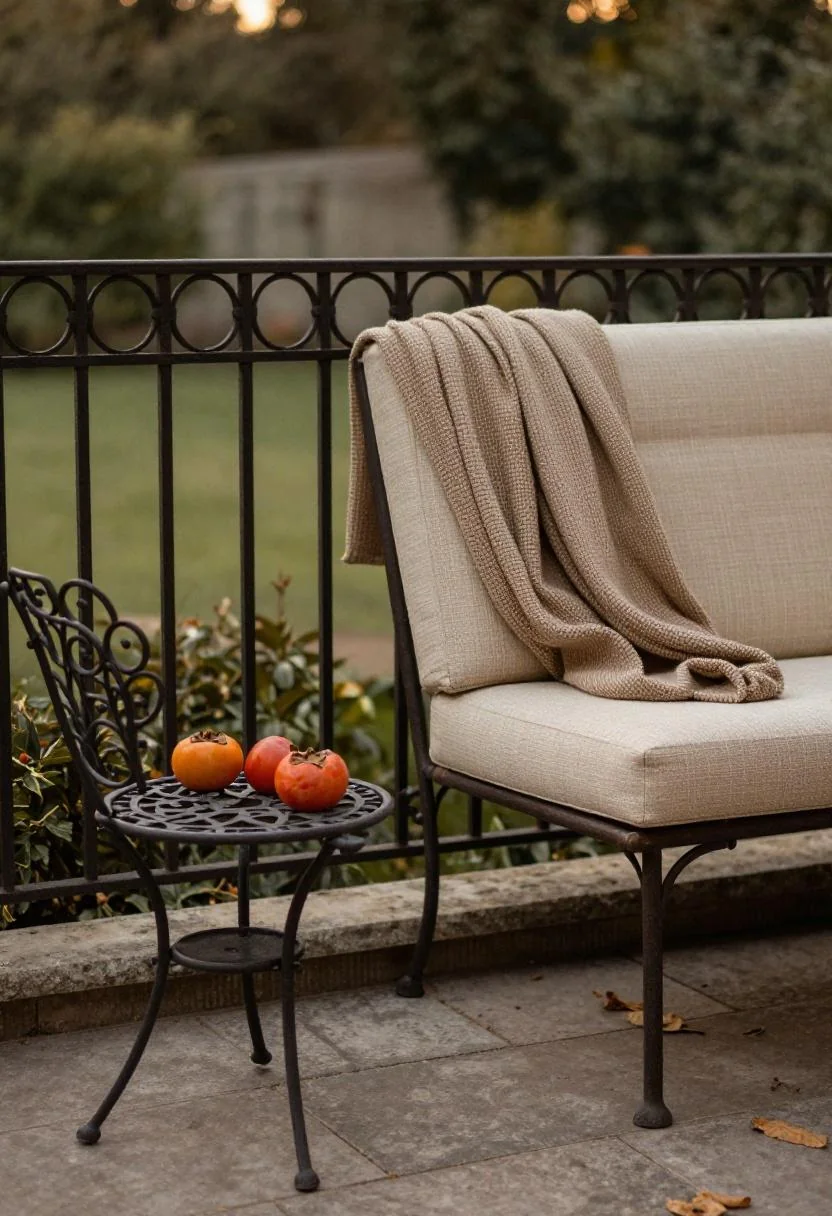
Persimmon cushion, wrought-iron fence, cast-iron bistro chair at dusk — this vignette feels like the south of France.
A persimmon outdoor cushion draped over a wrought-iron fence section above a cast-iron bistro chair at dusk creates a complete outdoor room vignette in approximately three square feet. The warm persimmon against dark iron is a classic combination — it shows up on café chairs from Paris to Barcelona, and there's a reason it never ages out. The draped cushion is a casual touch that softens the iron's formality without undermining it.
What makes this work as fence decoration specifically: the fence is a participant, not just a wall behind the chair. That shift in thinking — from fence as boundary to fence as furniture partner — opens up a lot of design possibilities. As Vogue has noted in recent outdoor living coverage, the most compelling outdoor spaces treat every vertical surface as a design element rather than a blank divider.
The Entry Fence: First Impressions
The most important fence section in your yard is the one people see first. The entry. And it deserves the most considered treatment of all.
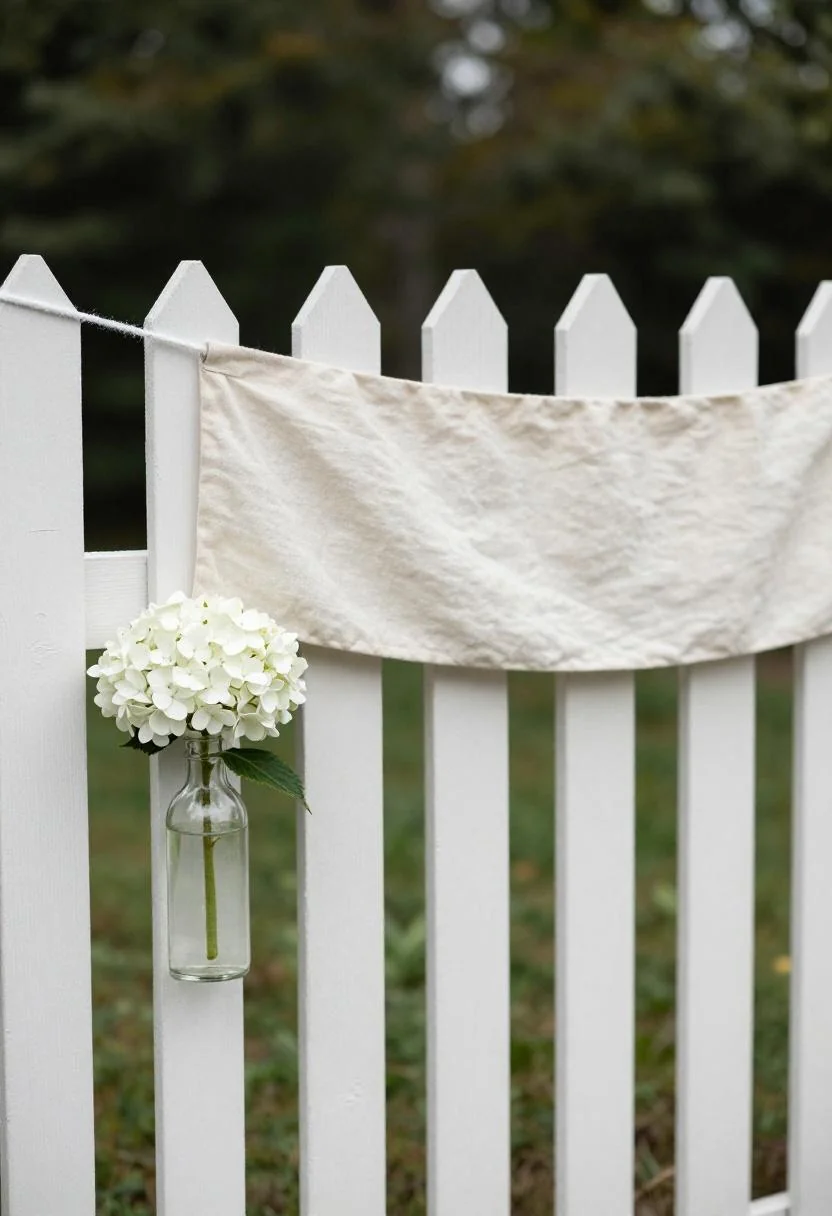
Cream white bunting and a hydrangea stem at the picket fence gate — simple, intentional, and exactly right.
Cream white linen bunting and a single hydrangea stem on a painted picket fence gate. That's it. That's the whole decoration. And it works precisely because it doesn't try to do too much — the picket fence itself carries the traditional charm, and these two additions simply acknowledge the entrance rather than overwhelm it. Linen bunting ages gracefully, softens in sun and weather, and has a handmade quality that plastic alternatives can't touch.
For seasonal variation, swap the hydrangea stem. A single stem of flowering quince in spring. One dahlia head in late summer. A sprig of holly in winter. The bunting stays. The single bloom changes. You've created a tradition without creating a project, and that's one of the most satisfying things in home decoration — when the framework does the work and the details provide the variation. Thinking about your seasonal display strategy as a whole system rather than a series of individual projects makes this approach much easier to maintain.
Making It Your Own
The through-line in all thirteen of these looks — from the mounted rosemary planters to the entry-gate bunting — is intention. Not budget. Not skill level. Intention.
Key Colors and Takeaways From This Collection
Cool Blue reads as aged metal, traditional ironwork, European craft — use it for planters and enamelware to add a timeless quality without going rustic.
Plum Noir anchors dark metal pieces; the depth in this tone works especially well in evening-lit vignettes where it catches warm light differently than flat black.
Jade Green is the standout color for ceramic work — it has a classical pottery association that makes inexpensive pieces look collected.
Persimmon and Terracotta are the warm counterbalances — use them to humanize dark iron or stone-heavy arrangements.
Cream White and Sage Green are your neutrals, but active neutrals — they contribute softness and breathing room without disappearing.
The approach that works: pick two or three colors from this palette, repeat them across your fence sections, and let the materials — wood grain, ceramic glaze, aged iron — do the rest of the work. A fence that feels designed isn't one that has more on it. It's one where every element was placed rather than just hung.
This post contains affiliate links. We may earn a commission at no extra cost to you.
Images in this article were created with AI assistance.


